How Wine and Food Content Performs on YouTube: Data-Driven Insights
Our company started with a simple conviction: that the most interesting wines in the world are also the least known ones.
The small producers, the forgotten grapes, the bottles that are hard to find: these are the wines, as well as artisanal foods like extra virgin olive oil and hazelnuts, that are the ones worth seeking and talking about.
Talking about them is exactly what our YouTube channel was made for: we started it as a home for our VeroTalks, which are intimate tasting conversations with the producers behind our wines.
Then, realizing that wine lovers and foodies use YouTube to learn and deepen their passions, we made a deliberate shift: to produce our own original content for people who prefer to discover more about wine and food, not just through through video, but also with the kind of storytelling that gives a wine its full meaning.
Out of all the social platforms, YouTube has become something genuinely different; it rewards those that prefer deeper engagement and real conversations. Since Vero was built around wines that deserve more than a passing glance, this platform makes it an especially valuable place to show up. So much so, that we decided to have a second annual look at what our YouTube audience watched the most. And, like how we discovered in our first recap of our YouTube channel last year, the numbers tell us something useful. Not just about which videos performed well, but about what wine drinkers are genuinely curious about right now, and what kind of content earns their attention.
So what did our YouTube audience most enjoy and watch this past year? Read on.
VeroVino YouTube Channel Stats
Before we get into the videos themselves, here is where the channel stands, after digging into the stats from April 2025 through April 2026
Through May 2026, nearly 300 videos have been posted on our channel. The channel has accumulated over 209,000 total views, more than 5,000 hours of watch time, 1,800 subscribers, and nearly 2 million impressions since launching. Those are not vanity numbers; they represent a real and growing audience of people who sought out wine related content, clicked, and stayed.
Comparing back to one year ago, views grew by over 60,000 and average percentage viewed ticked up by over 2%, to nearly cracking the 50% mark, meaning the audience that found us was not just clicking and leaving, but they were staying and watching.
In short: more people found the channel, more people stayed, and more people subscribed. The numbers suggest an audience that is genuinely curious about wines, foods, and Italian olive oil that are genuinely sourced.
Let’s look at what built these numbers: the videos themselves.
The Best of the Best This Past Year
Not all videos are created equal, and the numbers make that very clear. To give a real sense of what resonated this year and why, we looked at each key metric separately, from the period of April 2025 through April 2026.
It is always interesting to see that what wins on views does not always win on engagement, and what earns the most clicks does not always earn the most watch time. Each “most” category of a metric tells a slightly different story about what our audience valued, and together they start to paint a picture of what good wine content actually looks like right now.
Here is what stood out:
Most Shared Video
Traditional ABRUZZO CUISINE: Foods and Recipes with 33 shares this past year.
Shares are one of the most generous forms of engagement when considering how people interact with a video once they have watched or are watching it.
A like is quick, but a share means someone thought the video was worth passing along to someone else, and that is a much higher bar.
On this past year’s data, this Abruzzo food-and-wine video led the channel in shares, which suggests that content rooted in a real place, a real kitchen, and a real cultural context still travels well.
This makes sense based on our experience too.
Food related content tends to feel immediate and relatable. Then when it is tied to a specific place with tradition and personality behind it, it becomes even more shareable.
Abruzzo may not be the first place people name when they think about Italian cuisine, which could be why the video caught attention. It feels a little unexpected, a little useful, and easy to recommend, causing a “Hey, you have to check this out!” reaction.
Most Liked Video
Learn the Language of WINE LINGO (Part 1) earned a total of 73 likes during the year time frame.
Likes are simpler than shares, but they still matter. Prominently featured under the video, the likes tell us which video viewers responded to most positively, even if they did not go so far as to share it. In this case, Wine Lingo Part 1 comes out on top, also in other categories, which says a lot about how strongly this kind of educational, confidence-building content resonates.
It is not surprising. Wine language is one of those subjects that can feel intimidating until someone breaks it down in a useful, friendly way. This video did exactly that, and the like count says that viewers appreciated the help.
Best Click Through Rate (CTR)
Yes, You Can PAIR PROSECCO With a Meal had an average 11.89% click-through-rate.
This is the strongest click-through rate (or CTR) in the one-year data, and it is a very good sign for the Prosecco category.
Clickthrough rate measures how often people actually clicked after seeing the video. A high number usually points to a strong title, a clear promise, and most importantly, a topic that immediately sparks interest.
Prosecco is a smart example because it sits in familiar territory but still challenges a common assumption. A lot of people think of it as an aperitivo wine, not a meal wine, so the title creates a little tension right away. That is exactly the kind of hook that makes people want to find out more.
Most Subscribes or New Subscribers
Learn the Language of WINE LINGO (Part 1) earned the channel 330 new subscribers!
Subscribers are one of the clearest signs that a video did more than attract attention. They show that someone watched, liked what they saw, and decided they wanted more. In the one-year data, this Wine Lingo “glossary” style video led the channel by a wide margin. This makes sense because this is the kind of video that builds trust. It does not just entertain or inform for a moment, but it solves a problem. For viewers who want to understand wine better, that kind of usefulness is exactly what makes them stay.
Best Viewer Retention
Why Are You Missing Out On ITALIAN WHITE WINES? was viewed for an average of 60.59% of the total video duration. This metric is especially interesting because it tells us how well a video holds attention once someone is already in. They say any video above 50% viewer retention is considered excellent.
At just over 60% average viewed, this video was the strongest retention performer in the one-year data set. This suggests that people did not just click out of curiosity, but they stayed with it for a large portion of the video.
The topic helps explain why. Italian white wines are still underappreciated by a lot of drinkers. This video was designed to combat this stereotype; it helps to frame Italian white wines as something overlooked and worthy of appreciation, therefore ripe for discovery. This helps create a natural incentive for people to keep watching and stay interested. It feels useful and full of that new discovery potential.
The Video With the Most: Impressions, Views, and Watch Time
Learn the Language of WINE LINGO (Part 1) really stood head and shoulders above the rest. Besides its two previous categories, it also was our video with the most views, impressions, and watch time with well over 47,000 views, over 550 hours of watch time, and nearly 130,000 impressions in this year alone.
This is the clear overall winner for the year, and it is the video that best represents what worked best on YouTube for Vero. It led in views, watch time, impressions, likes, and subscribers gained: it is about as strong a performance as a single video can have.
What stands out most is not just the scale, but the consistency. People saw it, clicked it, watched it, liked it, and subscribed after it.
That makes it more than a successful video; it makes it a signal. The audience is telling us, very clearly, that wine education performs when it is practical, approachable, and genuinely helpful.
As well, this was our top video last year in our wrap up… the trend continues!
What the Winners Have in Common
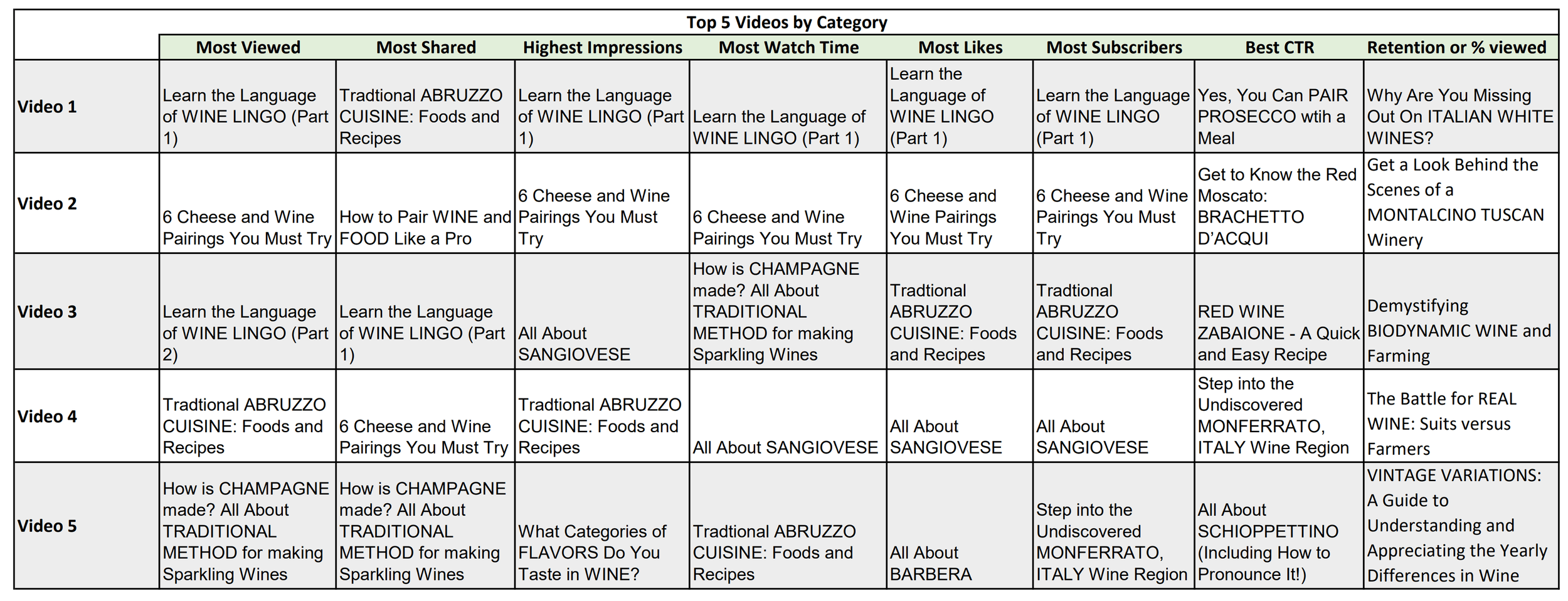
Look across the top videos and a clear pattern emerges: the winners are the ones that help people make sense of wine. Sometimes that means learning the language. Sometimes it means understanding a grape. Sometimes it means seeing how wine fits with food. But in every case, the video gives the viewer something fairly practical to hold onto.
That is why the best-performing videos are not necessarily the flashiest ones. They are the ones that make wine feel more usable.
For example:
Lingo videos do that by breaking down the words people hear but may not fully understand;
Cuisine and food videos do it by connecting wine to something familiar and shareable;
Challenging preconceived notions and giving new ideas and ways to think about something once dismissed piques people’s curiosity.
Even the high-retention videos tend to work because they give viewers a clear reason to keep watching: they are curious, specific, and useful.
The top-five chart makes the pattern even clearer. Wine Lingo Part 1, for example, appears across nearly every category, which tells us it was not just a one-off hit but a real anchor for the channel this past year.
At the same time, the rest of the top five are telling in their own way:
Barbera (our number two most viewed video of all time!),
and Schioppettino
all show up repeatedly.
This mix matters because it shows the audience is not only drawn to one kind of wine content, but rather drawn to content that makes wine feel more understandable, more usable, and a little more specific. The common thread is not just education, but education with something that has real world value. Something that can be applied to their actual wine journey. This might be a clearer term, a better pairing, a more interesting grape, or a fresher angle on something familiar.
What This Says About Wine Trends
This is where the bigger story comes into focus. The strongest videos suggest that wine drinkers are still curious, but they want curiosity to pay off. They are open to learning, but they want the learning to be relevant, practical, and a little surprising. In other words, they do not just want wine content, but rather they want wine content that gives them a reason to taste.
That matters because it lines up with a broader shift we see in wine behavior. Part of the decline in wine interest may be tied to palate fatigue: people get tired of drinking the same familiar styles over and over, and eventually they want something newer, different, or more vivid. The data here does not say that people have lost interest in wine. It says they are more selective about which wines, and which stories, are worth their attention.
The videos that perform best for Vero fit that shift perfectly. They take familiar entry points, like Prosecco, cheese, white wine, and Barbera, and give them a fresh angle. They turn a common wine topic into something that feels worthy to try and newly useful. That is a valuable signal for Vero, because it shows that the audience is not chasing novelty for its own sake. They are looking for discovery that actually helps them understand what is in the glass.
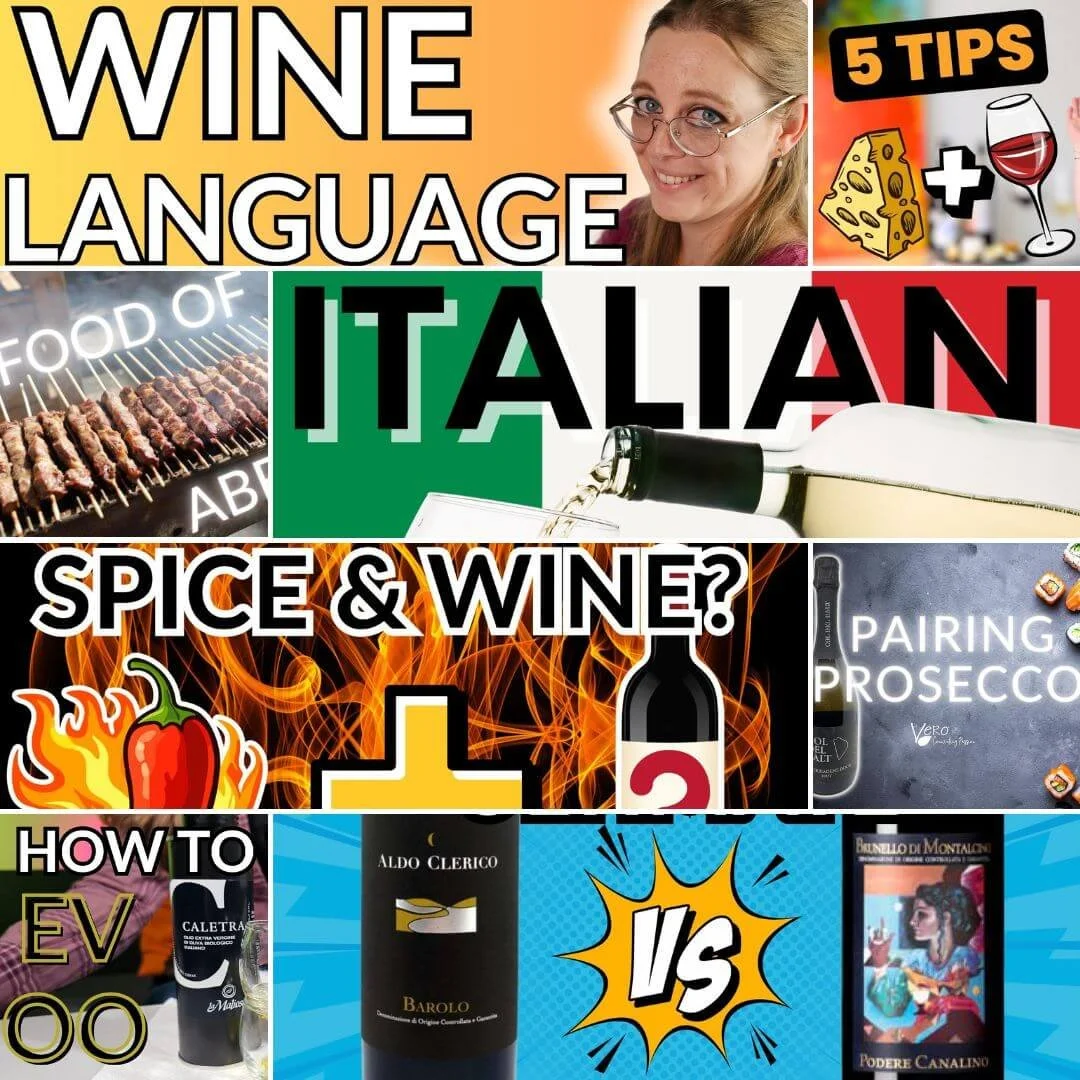
A selection of YouTube thumbnails.
This is also where our observations from our newsletter reader preferences fits naturally. Across both channels, our newsletter and YouTube, the same larger preference shows up: people respond to content that feels human, specific, and worth their time. In newsletters, that might look like a strong story or a clear point of view. On YouTube, it looks like a video that teaches, clarifies, or opens up a wine they had not considered before. Different format, same instinct.
Time to Taste the Trends
Thank you for following along with us and for being part of the Vero community. We love being able to share the wines, the people behind them, and the stories that make them special. For more articles, videos, and updates from our ongoing discoveries, subscribe to our YouTube channel and sign up for our free Vero Newsletter.
And of course, don’t forget to try the wines behind these trends! After all, we do all of this to make sure these amazing products end up in as many wine-lovers’ hands as possible to discover and enjoy along with us. We sell these curated small production, farm to glass wines to both businesses and consumers across the US:
If you are a distributor reach out to us introduce our highly curated portfolio of one of a kind small production wines to your state.
We sell to wine stores and restaurants in certain states - contact us to learn more.
If our farm crafted natural wines and olive oils are not in your local shop or restaurant, buy wine online here, and we’ll ship it to you, including wine gifts.
We also have an award winning wine club for true wine explorers that are seeking to continually discover unique, sustainable and authentic small production wines they never had. These are wines selected by our sommeliers and curated for each box.
We do corporate gifts and sommelier guided wine tastings. Email us and we’ll tailor unique and sustainable corporate gift ideas.
Some Wines That Feature in Our Videos
Most Shared: Abruzzo Food Pairings
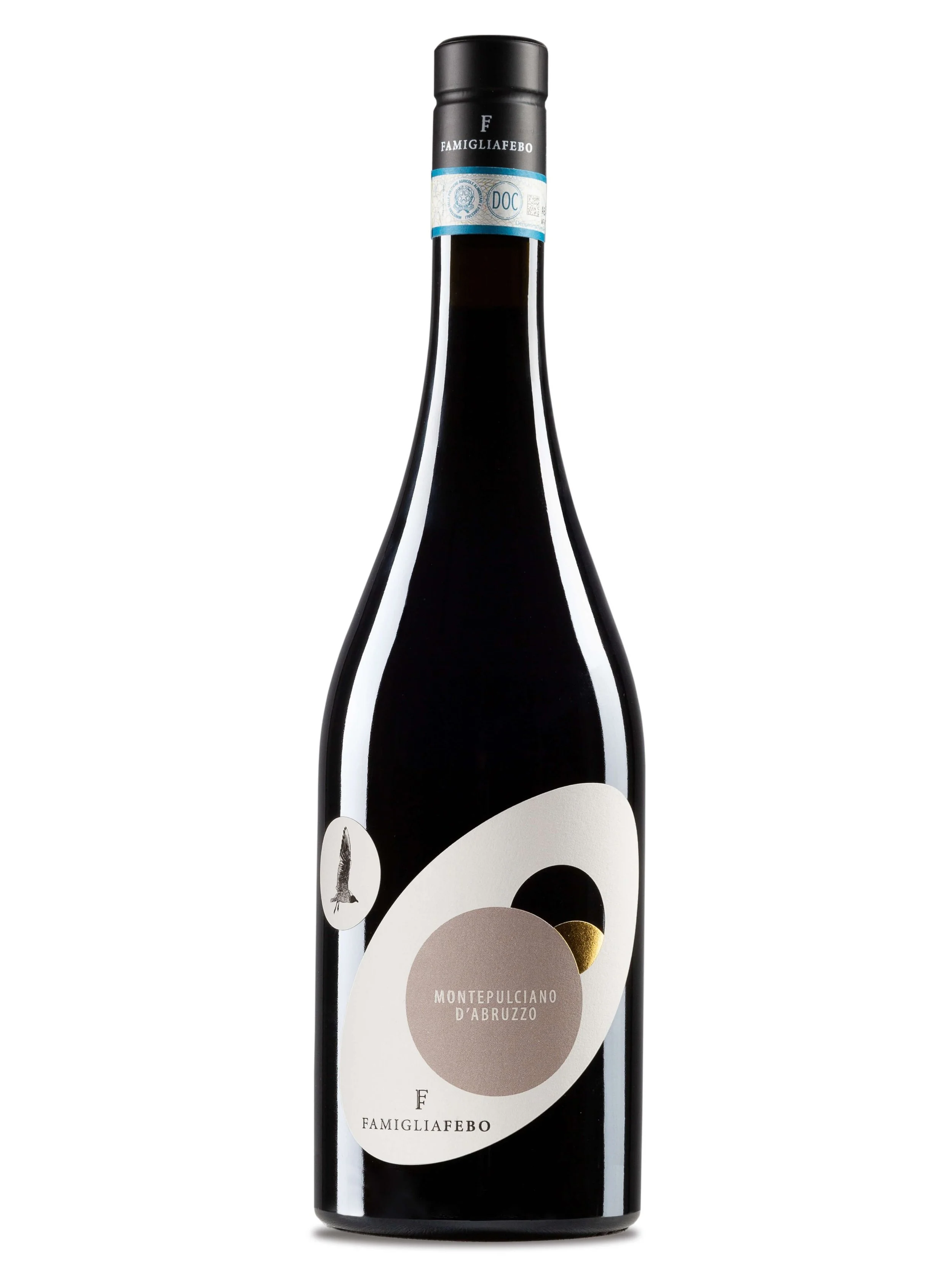
Made with 100% Montepulciano grapes spanning family vineyards in Spoltore and Chieti in Abruzzo, it has aromas of amarena cherries and licorice and a slight funkiness thanks to its 100% natural production. It tastes of dark fruit, with a rich texture and slightly bitter finish, with the funky vibe continuing while tasting. Fermented and refined in the winegrower's grandparents' concrete vessels.
Region: Italy > Abruzzo > Spoltore & Chieti
Tastes Like: Dark fruits
Farming & Winemaking Highlights: Regenerative Agriculture | Sustainable Winery | Biodynamic | Native Yeast Fermentation | Vegan | Organic | Natural Wine
Fun Facts: Pairs nicely with chicken parmesan. | While there is a famous wine “Vino Nobile di Montepulciano” from Tuscany, this grape has no connection to it; the “montepulciano name” there comes from the town noame, where as here in Abruzzo “montepulciano” actually refers to the grape used to make the wine.
Best Click Through Rate: Prosecco Food Pairings

Made from Glera grapes in one of the best areas for Prosecco, Valdobbiadene, this is a crisp, clean delicious dry Prosecco DOCG with a light yellow color and lovely effervescence. It has notes of pear with a minerally flavor and a citrusy, slight bitter finish reminding you of the rich terroir where this wine comes from. This Col del Balt Brut Prosecco made by the Sanzovo brothers has approximately 5g of residual sugar. As well, it is a special Millesimato Valdobbiadene Prosecco Superiore, meaning not only does it come from the select Valdobbiadene “heart” of Prosecco, but it is also from a singular vintage, not a blend of multiple vintages like many Proseccos.
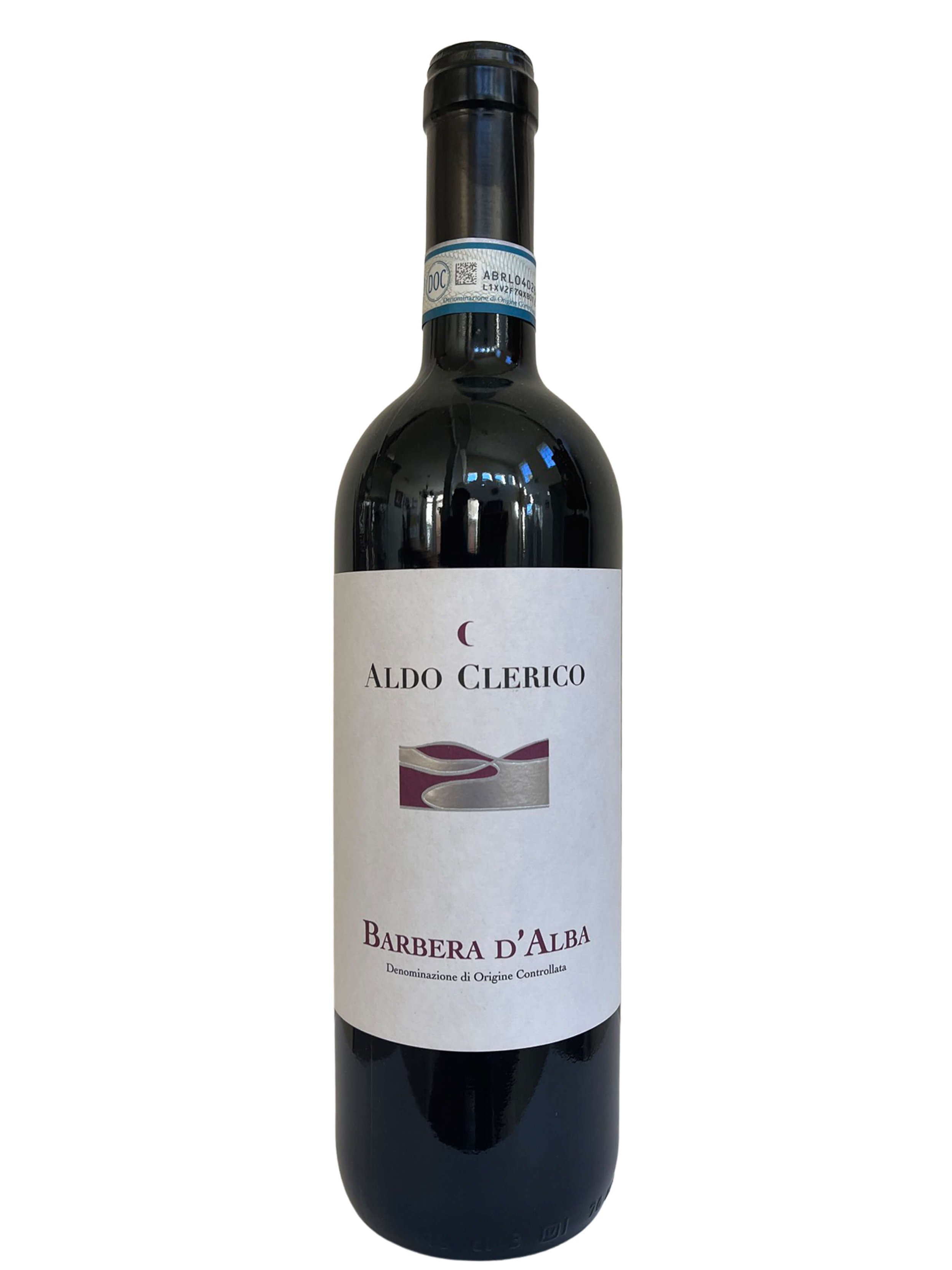
A really good, soft and fleshy Barbera from Alba, from a single vineyard located in the Barolo designated wine region, one of the best areas for Barbera. Nice acidity and fruitiness with some spice, thanks to 14-16 month aging in new and used oak.
A very balanced and elegant wine on the nose, and a good body and structure on the palate with a pleasant and vibrant acidity. A rounded wine with fresh yet fruity notes that finish with a creamy texture thanks to the oak barrel aging.
Do you want to regularly purchase this wine? Check out the Subscribe and Save option available HERE!
Tastes Like: Pretty, ripe, dark cherries
Farming & Winemaking Highlights: Biodynamic | Native Yeast Fermentation | Single Vineyard
Fun Facts: With its aging, this Barbera d’Alba technically follows guidelines for a Barbera d’Alba Superiore, but winemaker Aldo Clerico decides to declassify it.
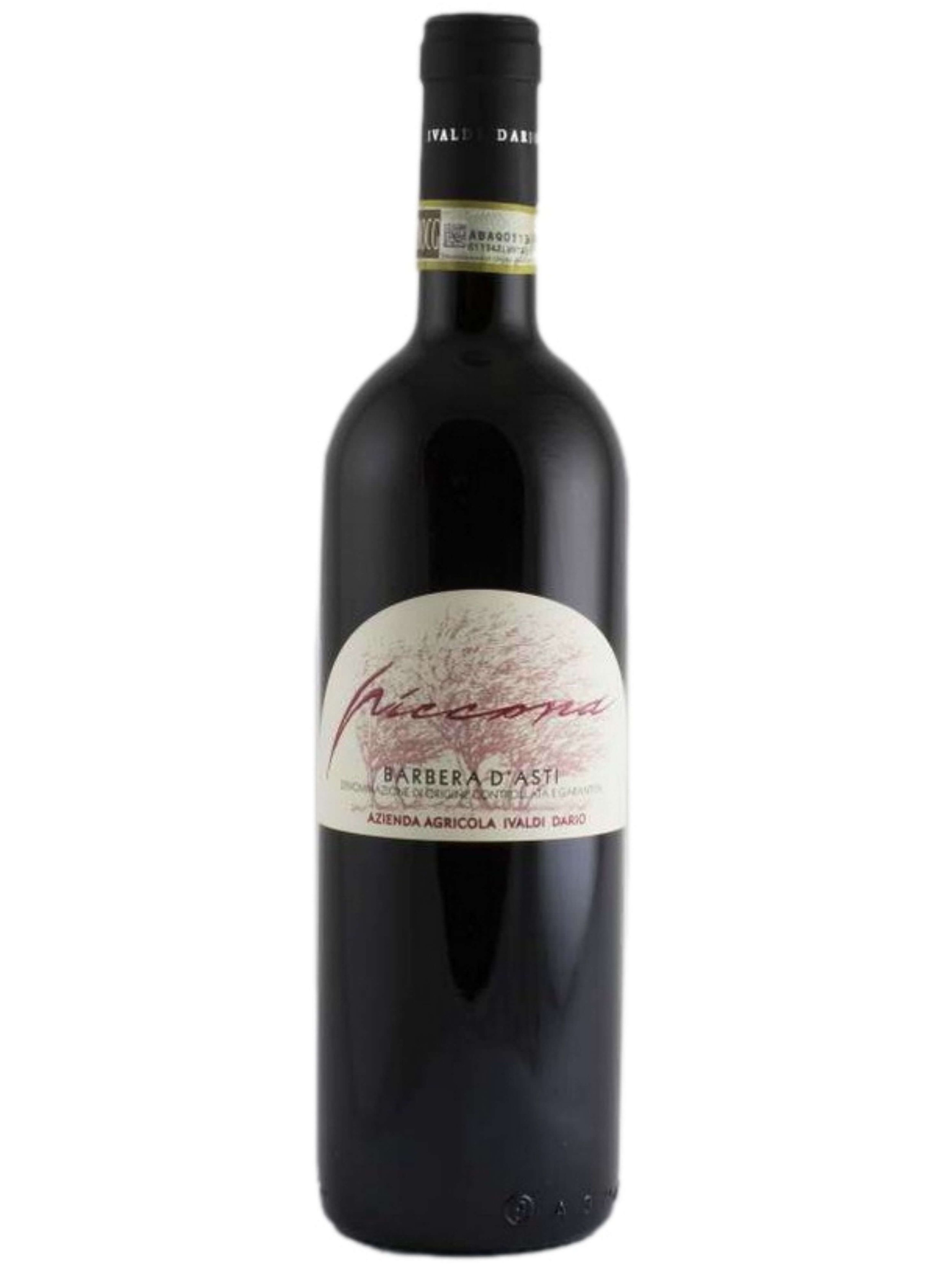
From the prestigious Barbera d’Asti denomination, this Barbera takes its name, Piccona, from the single vineyard where it is harvested in the Monferrato of Piedmont, Italy. A ruby red color, it has a complex bouquet of red fruits and berries. On the palate, the typical Barbera acidity comes through in a pleasant manner, balanced with the tannins and a certain robustness for an overall balanced and persistent wine.
A certified sustainable winery, Ivaldi Dario practices regenerative farming.
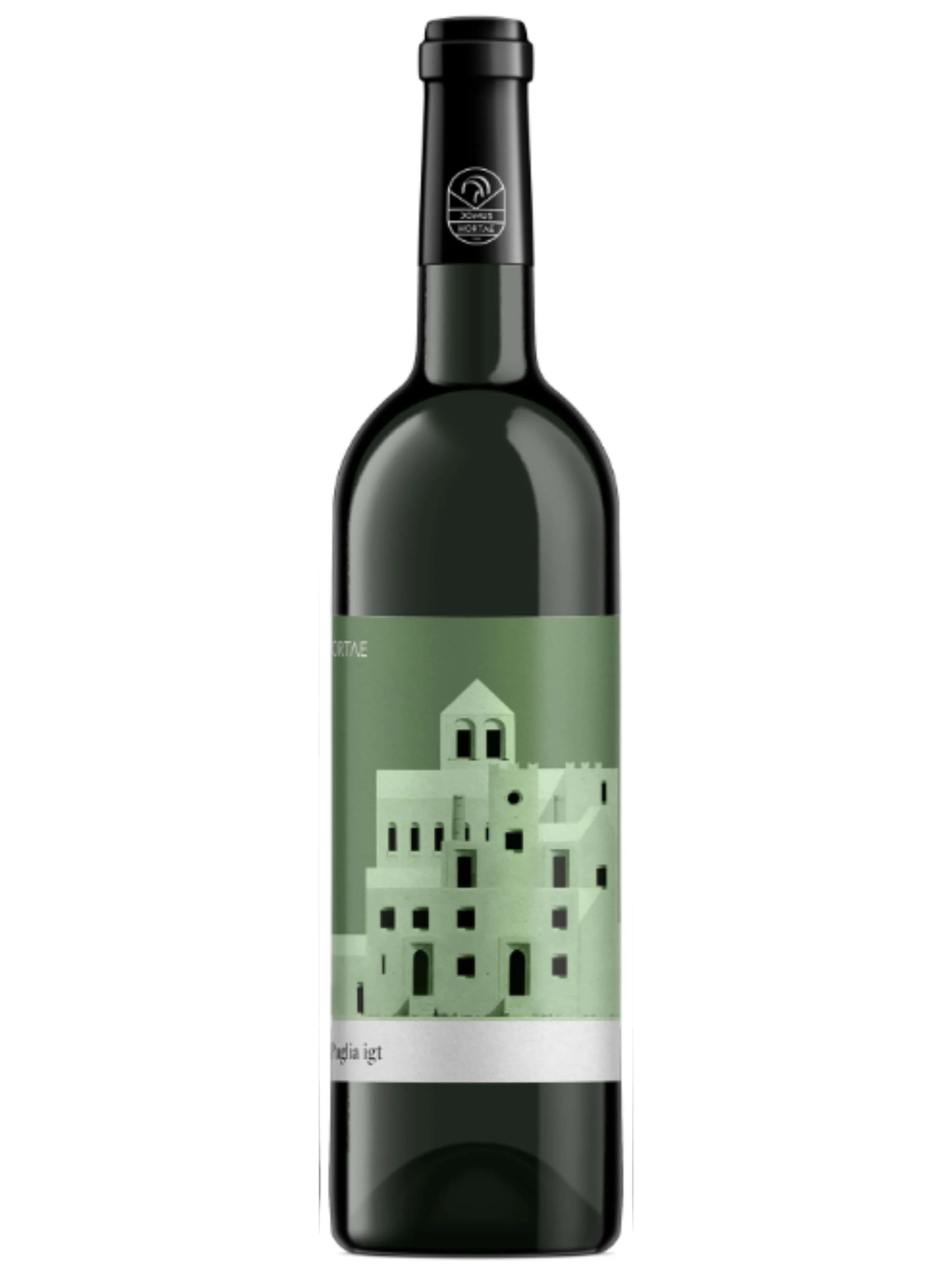
Ti estì means in the local Greek dialect 'what is this?' which gives you a clue about this wine. It is a monovarietal made by the Minutolo grape, which is an aromatic white grape grown in Puglia, Southern Italy, since 1200. Despite it being made in stainless steel, 'spicy' is a word to describe this white wine. The bouquet is intriguing, with white flowers, lemon and citrus candy and a hint of herbs. On the palette, tropical fruit flavors stand out, like lychee and banana.

An organic & vegan natural wine made from 100% trebbiano abruzzese, a white wine grape which the New York Times cites a grape “worth knowing better”. It has an inviting straw yellow color and an exotic nose (look for the saffron!) and an intriguing fruity and herbal taste.
This white wine is age-worthy too! Fermented and refined in grandfather Febo’s concrete vessels.
Region: Italy > Abruzzo > Chieti
Tastes Like: Peaches and Saffron
Farming & Winemaking Highlights: Regenerative Agriculture | Sustainable Winery | Biodynamic | Native Yeast Fermentation | Vegan | Single vineyard | Old Vine | Organic | Natural Wine
Fun Facts: This wine is named from the single vineyard from which it comes, Parella in Chieti.
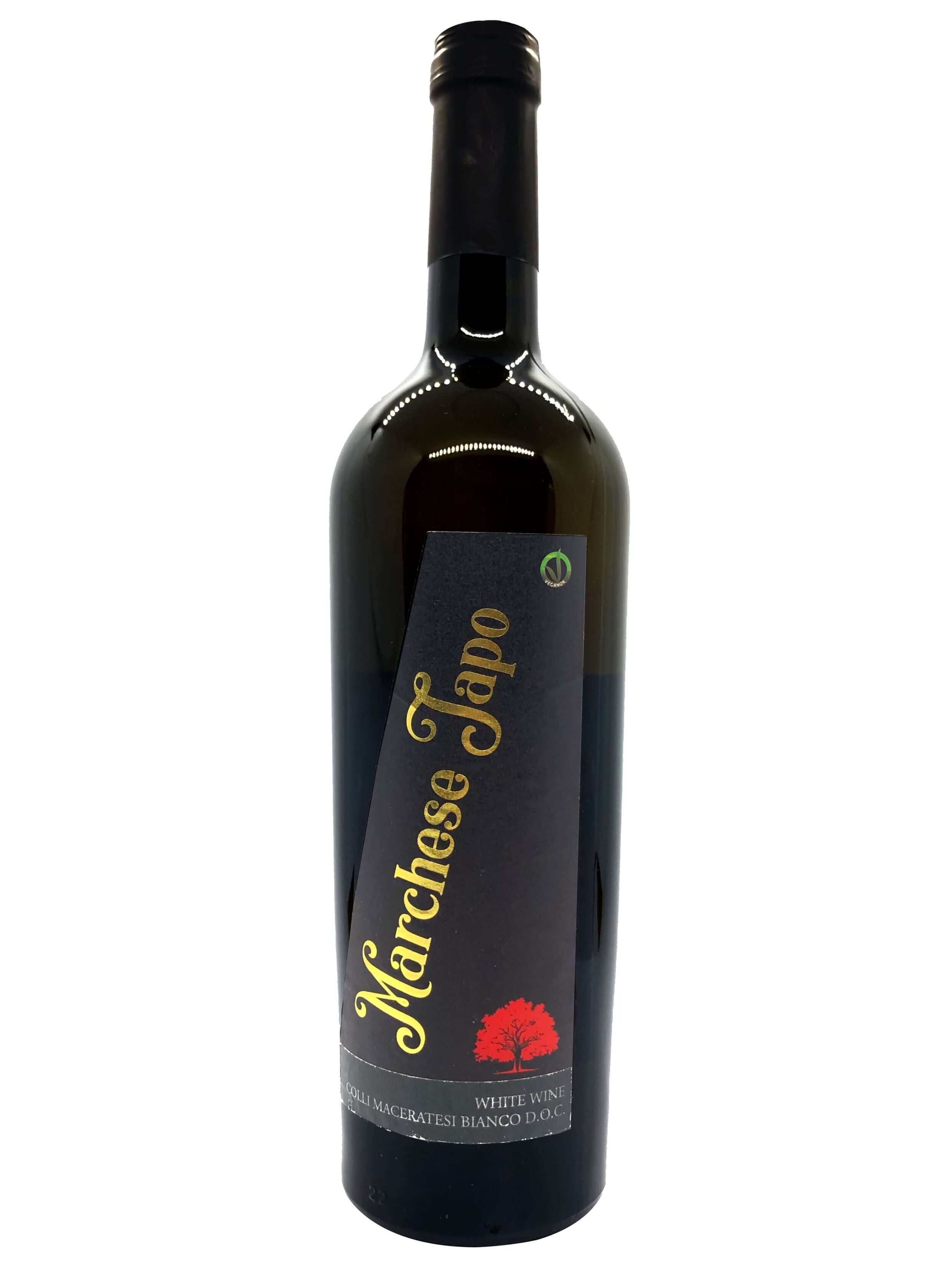
This natural wine is delicious fruit-forward organic vegan white wine, a blend of hard-to-find native varieties from the province of Macerata in Le Marche, Italy, a hilly area just to the east of Tuscany not far from the Adriatic Sea, has it all, great nose, taste, texture and structure. While it is unoaked, it was on the lees for 6 months with weekly battonage, contributing to its complexity of aromas, ranging from melon to saffron, and intensity of flavors. Made with indigenous varieties from Le Marche, Maceratino (also called Ribona) and Incrocio Bruni 54, it is a testament to Le Marche white wines.
Quercia Scarlatta follows a minimal intervention approach to vegan winemaking, using native yeast fermentation in their wines like this Marchese Japo.

Made from 100% Turbiana (considered similar to Verdicchio), this unoaked white wine from the sought after Lugana wine region has a bright yellow color, a natural balance of acidity and fruit with a textured mouthfeel and a long finish. It has inviting aromas of honeysuckle, tropical fruits, caramel and a hint of basil. Think of it as an alternative to an unoaked Chardonnay, since turbiana is also a noble white grape. Plus Zamichele’s terrroir with the influence from nearby Lake Garda and mineral rich glacial alluvial soil provides the conditions for creating a complex and balanced white wine.
Top 5 Videos: Schioppettino, Brachetto d’Acqui, and Sangiovese

Prepotto is the birthplace of the hard-to-find Schioppettino varietal. It gets its name from the Italian 'schioppare' or to burst, since the grape 'bursts' in your mouth when you eat it. Aromas and tastes of black pepper and plums. Fermented with indigenous yeasts and aged for two to two and a half years in oak barriques. Strong cheese lovers love to indulge in this wine.
Gold Medal Decanter, plus many other awards. Vigna Petrussa's oak-aged 2019 Schioppettino won the prestigious 3 Bicchieri Award by Gambero Rosso.
Vigna Petrussa is a certified sustainable and biodiverse women-owned winery.
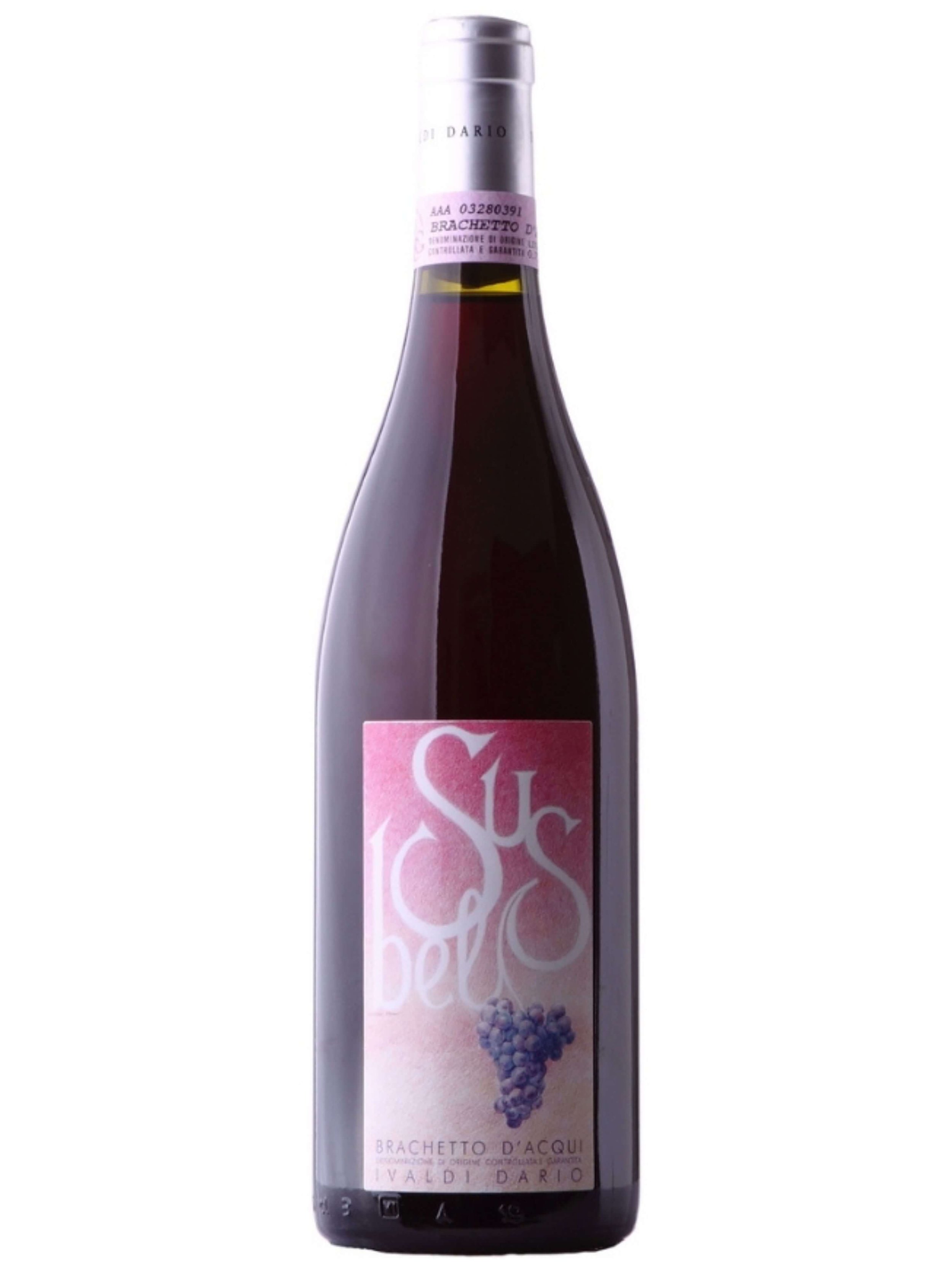
“Can we make Brachetto popular, please?” is how VinePair headlines why this artisanal, aromatic red sweet sparkling wine, just recently imported by us first time to the USA, made it to VinePair’s list of 13 Best Sweet Wines.
An aromatic grape, brachetto, creates a pleasantly slightly sparkling sweet red wine, with delicate rose flower and strawberry notes and strawberry and hibiscus taste. ‘Susbel’, in the local Piemontese dialect of Ivaldi in the Monferrato, refers to the location of the vineyard of this Brachetto d’Acqui, where the sun is bright and well exposed.
Left four days in contact with the skins and fermented with native yeast, this natural wine has a bright and clear light red color, dotted with fine effervescent bubbles. Sipping, the immediate impact is indeed sweet, yet with enough acidity and a hint of tannins to create a harmonious and balanced wine that keeps you coming back for more.
Wonderful to serve slightly chilled to sip with friends in the backyard on a hot summer day, or to serve with fruity desserts. Try pairing it with white or milk chocolate or a savory cheese, like with Humboldt Fog goat cheese - it goes incredibly well. It can also pair with charcuterie. Made with native yeast fermentation and has a residual sugar of 120 g/l.
A certified sustainable winery, Ivaldi Dario practices regenerative farming.
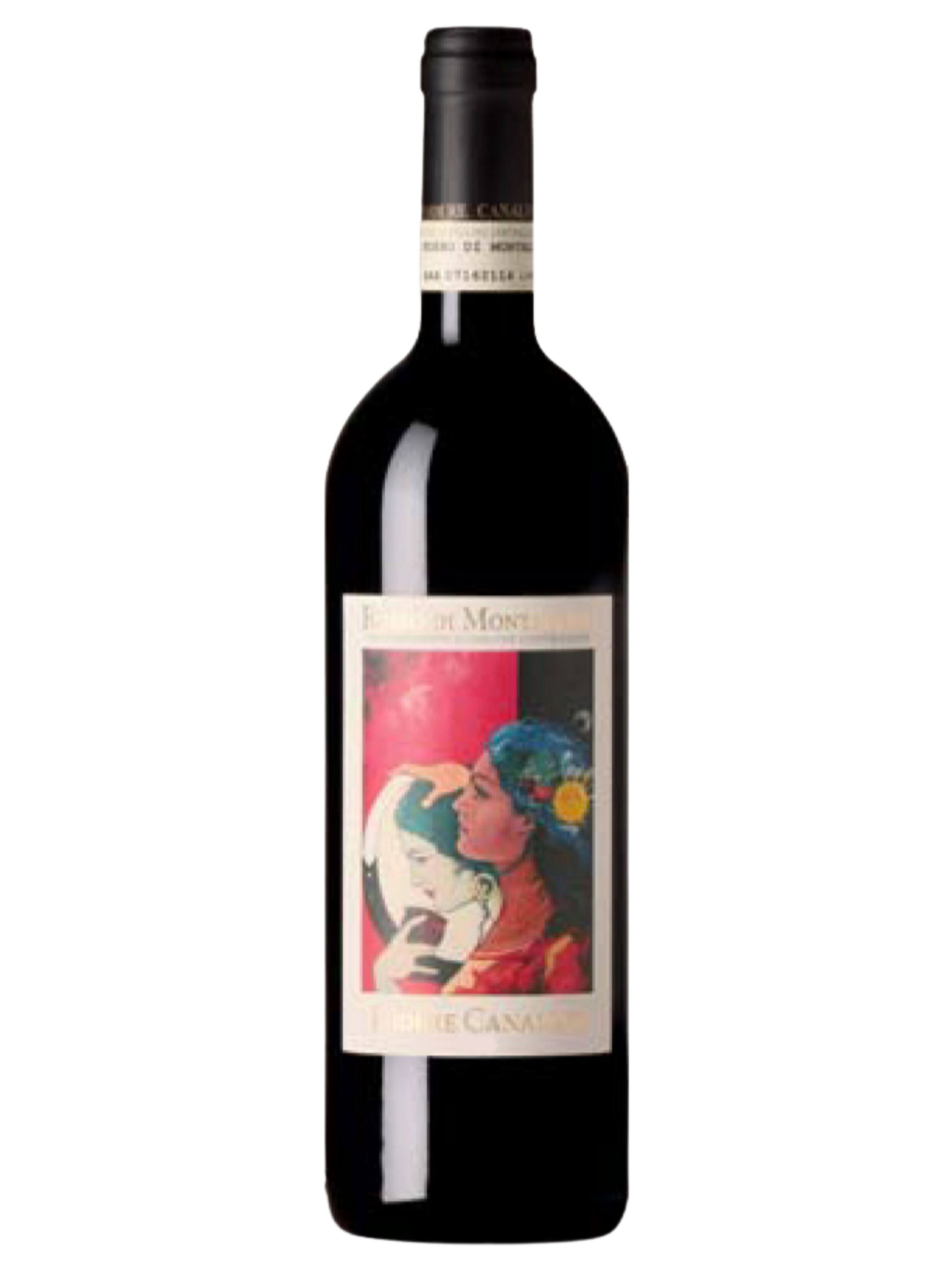
This is a complex, intense age-worthy vegan red wine; Once opened balsamic notes burst forth. We recommend to decant it or at least let it breathe a bit before tasting. When tasting, you understand that it comes from a terroir which one of the best Italian reds, Brunello, is made from; its structure is noteworthy, from acidity, to tannins to mineral structure. A delight for serious red wine lovers.
Tastes Like: Spiced Cherry Jam
Farming & Winemaking Highlights: Regnerative Agriculture | Sustainable Winery | Biodynamic | Native Yeast Fermentation | Unfiltered | Organic | Natural Wine | Vegan
Fun Facts: From 100% sangiovese vineyards right outside the historic center of Montalcino.

This wine is a rare treat, being one of the very few Sangiovese red wines grown on volcanic soil. This natural wine is a complex yet approachable. Tarconte is a distinctive old world style natural red wine with a touch of new world, having been aged for 36 months in oak barrels. Notes of earth, mineral, herbs, black pepper, it is super juicy with ripe tannins, a real food wine. A good pairing is with rosemary Asiago cheese. Don't be in a rush to enjoy it: open it and see how it evolves!
Tastes Like: A Baking Spice Cabinet
Farming & Winemaking Highlights: Regenerative Agriculture | Sustainable Winery | Biodynamic | Native Yeast Fermentation | Vegan | No additives (ie non sulphites added) | Unfiltered | Organic | Metodo Corino | Natural Wine
Fun Facts: - The natural farming method that produced this wine, the metodo corino, is actually patented by La Maliosa woman winemaker Antonella Manuli after she helped to develop it with natural wine legend Lorenzo Corino of Case Corini.
- Named after an Etruscan mythological hero.