Lambrusco Is the No-Brainer Wine You’ve Been Missing
There is a type of wine that works on a Tuesday night with leftover pizza just as well as it does at a Friday aperitivo with friends. It is low in alcohol, it sparkles, it loves food, and it has enough personality to keep things interesting. It does not ask for a special occasion, and it does not need one. That wine is Lambrusco: red, sparkling, and delicious. And if your first reaction to that name is a vague memory of something sweet and fizzy from the grocery store shelf, we get it. But that is exactly why we are here, because the real world of Lambrusco is so much more than that memory, and it deserves a proper introduction.
A great place to start to look for good Lambrusco and its kin is in the hills just outside Modena. There we find a winemaker named Irene Balim is crafting wines that show just how alive and surprising this category can be. But before we get to her, let's start at the beginning, because Lambrusco has a story that is worth knowing.
What Lambrusco Actually Is
To really appreciate Lambrusco, it helps to understand what it actually is, and what it is not. Most people treat it as a single wine, a single style, or even a single grape. But Lambrusco is none of those things. It is a family. One of Italy's oldest native grape families, in fact, with deep roots in the plains and hills of Emilia-Romagna.
The name carries a clue about its origins. Scholars believe it derives from an ancient term for wild vine, the kind that once grew freely along the edges of fields and forests, long before anyone thought to cultivate them. Centuries of farming and winemaking later, those wild vines became a remarkable collection of distinct grape varieties, each with its own character, its own preferred soil, and its own way of expressing itself in the glass.
And the differences between them are real. Lighter varieties like can lean floral and fresh, almost delicate. Heavier ones will go deep and dark, with structure and tannin that might surprise you. And when we lump in other red sparkling wines from the area that perhaps not are made with “lambrusco-approved” grapes, we see a variety that is astounding. These wines can be dry or off-dry, red or rosé, lively and immediate or more layered and complex. The category contains multitudes, which is precisely what makes it worth exploring.
We have spent some time in this world before, from the story of Irene Balim of Frignano as a producer, to a closer look at the Uva Tosca grape (one of those hyper-local, rare grapes used to make Lambrusco-Like non-lambruscos, to an earlier overview of Lambrusco itself where we got pretty nerdy. Those pieces are worth revisiting as companion reading, and to understand the world of Lambrusco as a whole, but today, we wanted to bring the whole picture together in a concrete way that shows why Lambrusco should be you next social sipper!
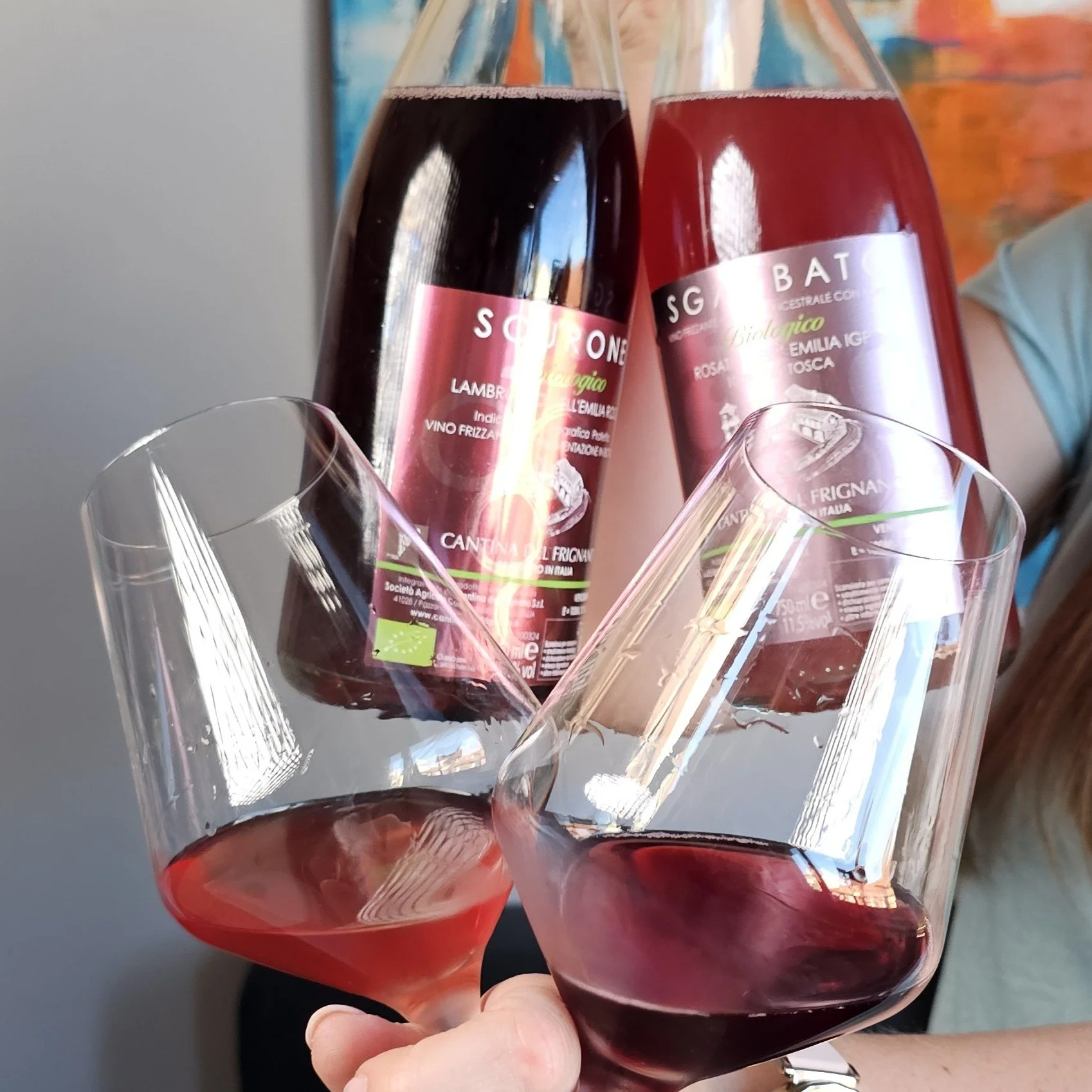
Sgarbato and Scurone, in the glass.
Why the Reputation is Incomplete
Here is the thing about Lambrusco's reputation: it did not get there by accident. For decades, the wines most widely exported to the US were sweet, mass-produced, and designed to appeal to the broadest possible audience. The result was a category that became synonymous with cheap and cheerful fizz, the kind of thing you might find in a jug on a grocery store shelf. And for a lot of wine drinkers, that first impression stuck.
But that version of Lambrusco was never the whole story. It was the loudest chapter, not the best one. Back in Emilia-Romagna, producers had been making dry, serious, genuinely delicious Lambrusco all along. These are wines built for the table, made with care, and rooted in centuries of local tradition, but they just never made it to most people's glasses.
The good news is that the tide has been turning for a while now. A new generation of producers is making Lambrusco that is natural, expressive, and deeply connected to the land. And wine drinkers who are willing to give it a second look are finding something that feels less like a throwback and more like a discovery.
Lambrusco is a Family, not a Single Style
So what does that diversity actually look like in practice? Think of Lambrusco less like a single wine and more like a whole cast of characters, each one shaped by a different grape, a different part of the region, and a different winemaking hand.
Some Lambruscos are built for lightness and lift. They are pale, almost translucent in the glass, with aromas that lean toward violet and red berries, and a freshness that makes them feel almost effortless to drink. Others go in the complete opposite direction: deep ruby, richly fruited, with tannin and texture that can hold their own against a plate of grilled sausages or a hearty ragu.
And then there is everything in between. Rosé expressions that blur the line between sparkling red and sparkling pink. Wines made with the charmat or tank method, wines made the traditional or champagne method, and wines made with the ancestral method that bring a wilder, more alive quality to the glass. Some are made entirely from a single Lambrusco variety, others are blended across the family.
The point is that if you have been thinking of Lambrusco as one thing, it is time to think bigger. The category rewards curiosity, and the more you explore it, the more you find, and most likely, if you think you don’t like Lambrusco, then you just haven’t met the right one yet.
Why Lambrusco Works so Well at the Table
There is a reason Lambrusco has been the house wine of Emilia-Romagna for centuries. This is a region that takes its food seriously; after all, it is home to Parmigiano Reggiano, prosciutto di Parma, mortadella, tagliatelle al ragù, and some of the most celebrated charcuterie in the world. Rich, fatty, deeply savory food that needs a wine that can keep up without overwhelming.
Lambrusco and its local red sparkling siblings do that beautifully. The bubbles cut through richness, the acidity keeps every bite feeling fresh, and the relatively low alcohol means the wine stays light and refreshing. It is one of those combinations where the food and the wine genuinely make each other better.
But here is what makes Lambrusco especially useful in everyday life: it does not need a big occasion or a carefully planned menu to shine. It works just as well with a casual pizza night as it does with a proper spread of antipasti or aperitivo. It is the kind of wine you can open on a weeknight without thinking twice, pour freely for a table full of friends, or sip on your own with something simple on the plate. Low in alcohol, lively in the glass, and endlessly food-friendly, that is a combination that is very hard to beat.
Frignano Crafting Modern yet Ancient Lambrusco
If you want to understand what a well made, artisan Lambrusco looks and tastes like, Frignano is a great place to start. This small organic winery sits in the hills just outside Modena, where the air is cooler and the soils are a mix of clay, limestone, and sand. It is the kind of place that feels a long way from the industrial plains where most commercial Lambrusco is made.
At the helm is Irene Balim, a woman who has devoted herself to the native grapes of her adopted region and to making wines in the most natural, hands-on way she can. That means organic farming, native yeast fermentation, and a commitment to the ancestral method, also known as pet nat, which gives her wines a lively, unfiltered energy that feels true to the spirit of the land.
What makes Frignano especially interesting in the context of Lambrusco is that Irene is not just making one style. She is exploring the full range of what these grapes and this place can do. The two wines we are focusing on today show that range clearly, and together they make a compelling case for why this corner of Emilia-Romagna deserves your attention.
Sgarbato: the grape, the style, and the taste
Sgarbato is the more unexpected of the two wines, and that is part of its charm. Technically, it is not a Lambrusco at all, but it lives in the same conversation, a Lambrusco-like sparkling wine from Emilia-Romagna that shows how much this part of Italy still has to offer beyond the familiar names.
It is made from Uva Tosca, a rare local grape that Irene is helping to bring back into focus. The wine is made in the ancestral method, with native yeast fermentation and bottling on the lees, which gives it that slightly wild, energetic feel in the glass. It is a wine that feels very much alive.
On the palate, Sgarbato is all about brightness. It is fresh and juicy, with a cranberry-like snap, strawberry on the nose, and a clean saline finish that keeps the wine feeling lifted and refreshing. It has that easy, quaffable quality that makes it feel instantly inviting, especially if you like sparkling wines that lean more savory and refreshing than sweet or plush. It is so refreshing, it really reminds us of almost like a Kombucha in acidity, pep, and fruitiness. This is the bottle for aperitivo, for salty snacks, for lighter fare, or for any moment when you want something sparkling that feels playful but still has a sense of place.
Scurone: the grape, the style, and the taste
Scurone is the more grounded wine, and it shows a very different side of the region. This one is built from Lambrusco Grasparossa with a touch of Malbo Gentile, another local grape that adds a little extra body and richness to the blend. Like Sgarbato, it is made in the ancestral method with native yeast fermentation and bottled on the lees, so it keeps that raw, lively texture that makes these wines feel so immediate.
In the glass, Scurone goes darker and deeper. The fruit leans toward sour cherry and blacker berry tones, and there is more grip here, more structure, more tannin. Malbo Gentile softens the edges and adds depth, but the wine still keeps a fresh, youthful energy that makes it feel vibrant rather than heavy. It is the kind of Lambrusco that wants to be noticed.
If Sgarbato is the bright, lifted, almost teasing side of this world, Scurone is the one with more backbone. It is a great wine for richer savory food, grilled meats, and anything with enough flavor to meet its texture halfway. It is still lively and easy to enjoy, but it has a darker, more serious presence in the glass.
Why Lambrusco is a No-Brainer
These two wines are a perfect example of what we love most about Lambrusco: they are distinctive, flavorful, and full of personality, yet still easy to enjoy in everyday life. If you are curious to taste what this region can do, they are both ready to explore. For those of you that know our curation style, you know that we love to support small producers and bring you unique and fun wines, and specialty foods. And you can enjoy these curations by trying a selection of different wines, foods, and olive oils from our portfolio. We sell to both businesses and consumers across the US:
We are enlarging our network of distributors around the country. Reach out to us if you are interested in distributing our products.
We sell to wine stores and restaurants in certain states - contact us if you would like more info.
We do corporate gifts and sommelier guided wine tastings. Email us and we’ll tailor unique and sustainable corporate gift ideas.
If our farm crafted wines, specialty foods, and olive oils are not in your local shop or restaurant buy wine online hereand we’ll ship it to you, and we ship to most states.
We also have an award winning wine club for true wine explorers seeking to continually discover unique, sustainable and authentic small production wines they never had.
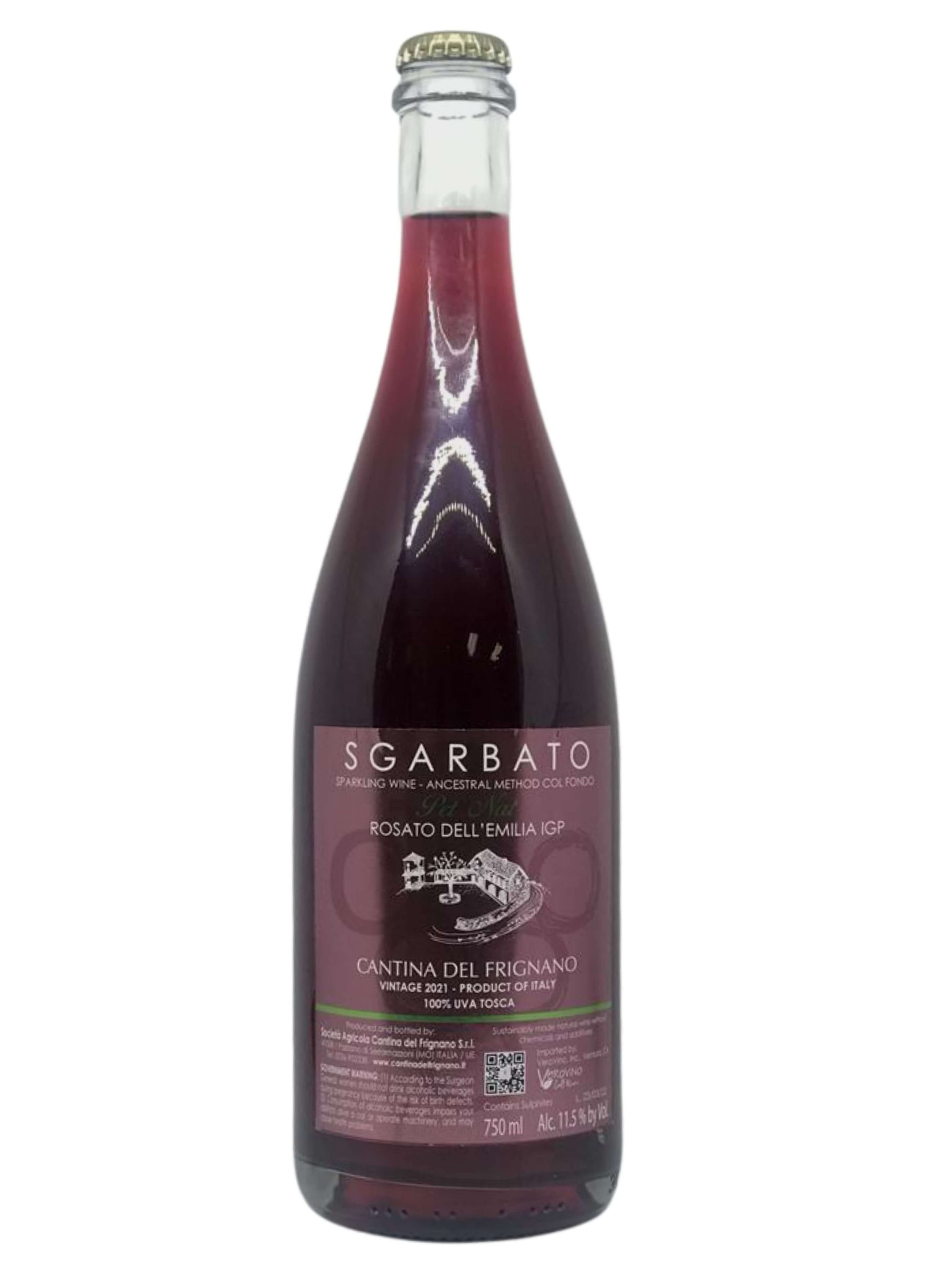
Made from the rare Uva Tosca grape, this dry Pet Nat tastes like drinking cranberry juice as a sparkling wine.
This producer, Frignano, is credited for reviving this forgotten grape which grows in higher altitudes in Emilia area of Northern Italy, and is believed to be a descendant of Schiava Grossa, the Alto Adige red grape.
Refreshing and quaffable, with strawberries on the nose and a saline finish, it is great on its own or with light fare. It is an unfiltered, bottle fermented 'col fondo' sparkling wine also known as ancestral method or Pet Nat style, and made with spontaneous fermentation like a natural wine.
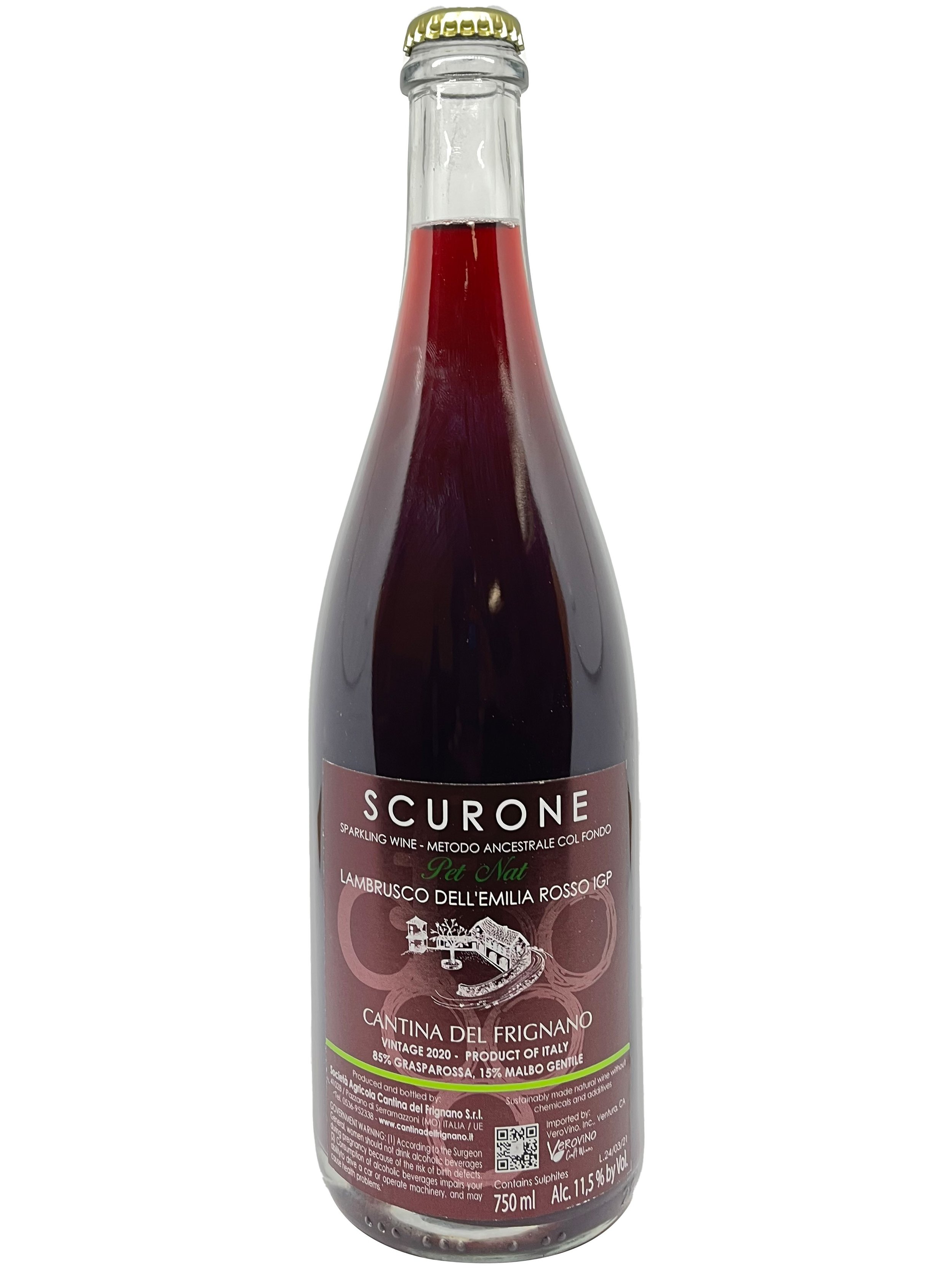
This is an ancestral method Lambrusco made primarily with the Lambrusco Grasparossa grape, and with some Malbo Gentile grape, which is local to the area of Frignano in Modena. It is a lighter red ruby color, light effervescence, a nose that has red fruit with hint of orange peel. It is fresh and fruity, with plum taste, and grippy tannins and noticeable texture.