
Farming for the Future is a Win-Win for All
Do you want to drink the best possible wine for your palate and for our planet?

Co-creators of the Corino Method for natural wine production, Antonella Manuli, founder of La Maliosa in Maremma Tuscany, and Lorenzo Corino, viticulture researcher and 5th generation wine grower-maker in Piedmont, Italy.
Full of healthy microbiology, natural wines come from grapes grown organically from a thriving habitat and transformed in the cellar into wine using native yeasts, minimal intervention and minimal sulfites, and without using additives or other processing aids including fining and filtering. Natural wine is alive: living wine made from living soil.
Makers of natural wines seek: involvement in growing grapes, integrated pest management, habitat for predators that prey on vines, a reflection of place of origin, biodiversity, a closed system shunning irrigation and fertilizers from outside the farm, carbon footprint reduction, reduced impact to the planet over time, a supportive community for all species, and financial security for employees.
This philosophical perspective takes a 360 degree approach to address everything in sight from the grape to the glass. Thinking about promoting prosperity for planet and people instead of only profit for the business is known as "The Triple Bottom Line" and proponents advocate social measures that promote equity, and environmental strategies that guarantee environmental stewardship.
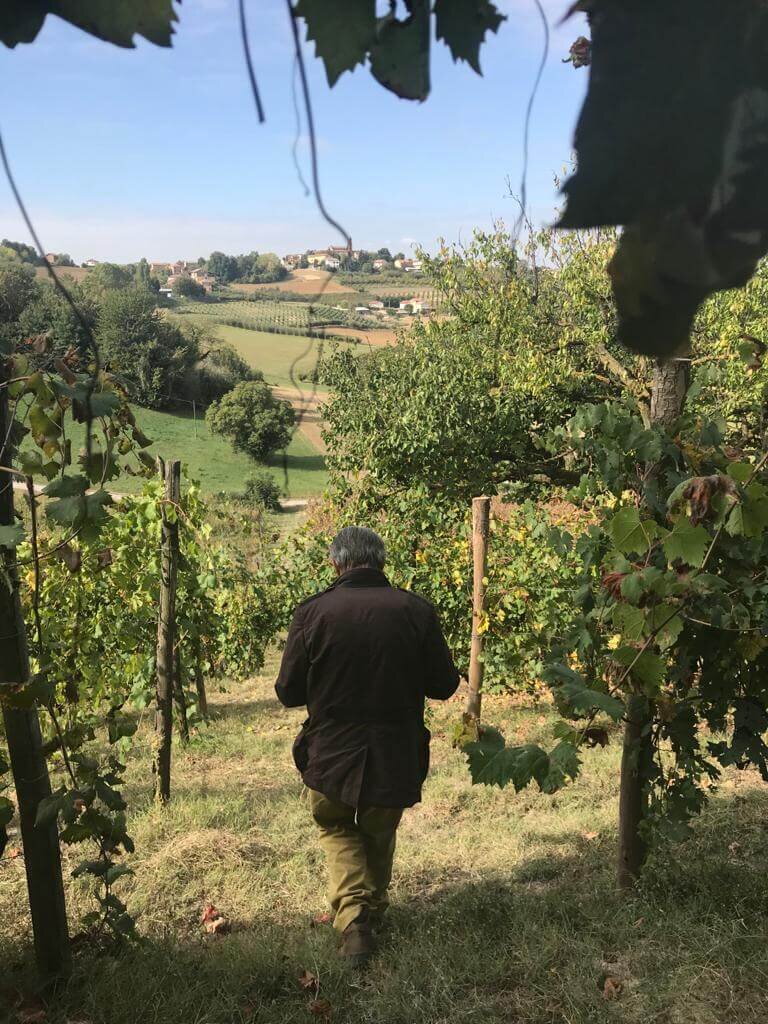
Regenerative Agriculture Pioneer and creator of the Corino Method, Lorenzo Corino, walking in his natural vineyards in Northern Italy.
Part two of this series on sustainability and natural wines.suggests that choosing wines made naturally and grown organically and sustainably using regenerative agriculture like the wines from La Maliosa and Lorenzo Corino / Case Corini which follow the patented Metodo Corino fill the bill of better for you and better for Earth.
Growing organically is important but there's more to farming than avoiding pesticides and fungicides. Regenerative organic agriculture grows vines that take up more nutrients because this method of farming builds up the top soil and more.
Regenerative Agriculture: Tastes Better
Wines made from regenerative organically grown agriculture, which includes biodynamic products, taste better, have more nutrients, and are better for the planet generally and the climate crisis specifically.
“Organic and biodynamic wines showed much higher quality,” reports Magali Delmas, an environmental economist at UCLA’s Anderson School of Management about her recent research. “It’s another example of sustainable goods providing additional benefits to consumers.”
In their research, Dr. Delmas and her colleague Olivier Gergaud, who is Professor of Economics and Director of Centre of Excellence Food, Wine and Hospitality at KEDGE, “found that organic wines are judged to be higher quality by experts.” In the third party judging used in the study, the organic wines scored 6.2% higher than commercial ones, and biodynamic wines did even better scoring 11.8% higher.
Regenerative Agriculture: Better for Earth
According to Patagonia founder Yvon Chouinard, the most important solution to the climate crisis is regenerative agriculture.
Regenerative agriculture is also key to producing the best possible wine for your palate and the planet because regenerative agriculture replaces nutrients missing from the soil-- and these nutrients provide flavor, complexity and finish to the wine in your glass.
All life depends on 6” of earth; in conventional agriculture farmers spend all their money on chemicals and machinery, and they lose topsoil in the conventional processes they use. Regenerative agriculture holds on to those 6″ of precious topsoil and preserves it because regenerative agriculture captures carbon by not tilling, holding the carbon in the ground where it belongs. Regenerative agriculture supports soils by increasing organic matter. That organic matter, dead or alive, is made of carbon, which as it dies is sequestered in the soil. Scientists measuring carbon going from the air into the ground in regenerative protocols extrapolate that if this type of farming went to scale, we could put back into the ground the carbon we are releasing.
"Soil is an organism and you have to try not to disturb too much," says Lorenzo Corino, a regenerative agriculture practitioner in Italy. "Tilling is disturbing. It is much better to work with herbs or to mulch the soil. Of course it takes longer."
How a product does less harm AND does more good.
Regenerative agricultural products including wine:
taste better; there’s a direct correlation between taste and nutrients
take organic further
sequester carbon
employ more people
use less water; the ground is alive and full of plants which hold the water
Biodynamics and the Metodo Corino are forms of regenerative agriculture where farming seeks to restore the soil and the planet. These farming practices see the vineyard as part of a farm that exists and thrives as one solid, integrated organism, a self-sustaining ecosystem that functions as a whole, with each part contributing to the rest.
In regenerative agriculture, the farm is a self-sustaining system; natural materials, soils, and composts from the immediate area support the vitality of the vineyard. Farming is not extractive but regenerative making the farm healthier each year. In addition, biodynamic practitioners use special biodynamic preparations to activate specific processes in the vines and the soil plus they take into account biological and cosmic rhythms.
"I trust the moon," says Lorenzo Corino who developed the Metodo Corino with Antonella Manuli of La Maliosa. "The moon is very important. When a new moon, the vines grow faster. The moon is something we know well and follow."
While both biodynamics and the Metodo Corino pay attention to the health of the soil and to the rhythms of the cosmos, biodynamics uses animal substances in the various preps that are applied to the vineyard, while vegan the Metodo Corino uses all plant products. For example, instead of animal manure, La Maliosa's Antonella Manuli places mulch in her vineyards, and plenty of it; they even grow their own hay for this use.
“Hay mulching has many functions,” Antonella Manuli says. It provides shade, making the land “favorable to life in the soil,” and mulching stops erosion completely.
Tuscany's Maremma, home to her farm, is “subject to long periods of drought so you can have a lot of damage done to the soil life,” she explains. Hay mulching “keeps the moisture for a long time when it rains and maybe we don’t have rain for 4-5 months we can keep moisture in the soil.” With the hay mulching, the soil is “very slow to absorb the moisture.” At La Maliosa, they don’t get a lot of rain and they can’t afford to lose the moisture because “we don’t irrigate artificially. When you use vegetable (material) it’s very slow and goes on a long time and gets absorbed in the soil.”
There’s a difference between vegetable inputs and carbon inputs in terms of the carbon footprint also. “When you have grass and covering, you have absorption of carbon,” Antonella explains. “What we are doing when we use the hay mulch we are trying to replicate what is happening on forest soil.” The soil that you have in the woods, in a forest, is the best for wine grapes she thinks.
The environmentally conscious and sustainable Metodo Corino is a patented method of wine grape cultivation and production that seeks complete transparency. Lorenzo and Antonella worked together to develop a protocol and a process, which they named the Metodo Corino. Lab tests showed significant differences, and with the production of a scientific paper, they asked for and received a patent in May 2019.
The Metodo Corino sustainability practices include measuring and reducing the carbon footprint of the winery, for example using more light weight bottles and packing materials. Native yeasts but no chemicals are used except, rarely, sulphur and copper as needed. The farm is seen as a complete ecosystem, and they keep as much organic matter as possible with hay mulching improving the soil and making water more available to the vines.

Vines ready for harvest in Lorenzo Corino’s Natural vineyard, showing the true natural beauty of regenerative agriculture.
In summary, the Metodo Corino:
Uses no water from outside the farm
Keeps soil covered
Works with very little mechanization
Uses electric rechargeable equipment
Uses vine varieties adapted to terroir
Maintains woods in the farm
Grapes grown using the Metodo Corino help protect the planet and produce a better wine for your palate.
Natural Wine: Better for you
Full of healthy microbiology, natural wines come from grapes grown organically from a thriving habitat and transformed in the cellar into wine using native yeasts, minimal intervention and minimal sulfites, and without using additives or other processing aids including fining and filtering.
Anecdotal evidence suggests that people who have bad reactions to wine, like hives, headaches, and hangovers, do not have these unhealthy reactions when they enjoy natural wines in moderation. Conventional commercial wineries in the United States have access and permission to use hundreds of artificial additives, chemicals, and other products when they make wine --and which they don't have to disclose. Some natural wines, especially biodynamic ones, last longer after being opened than conventional wines do, meaning it's not necessary to rush through a bottle fearing that it will spoil after being exposed to oxygen.
Do you want to drink the best possible wine for your palate and for our planet?
Then choose wines made naturally and grown organically and sustainably using regenerative agriculture like the wines from La Maliosa and Case Corino which follow the patented Metodo Corino.
Growing organically is important but there's more to farming than avoiding pesticides and fungicides. Regenerative organic agriculture grows vines that take up more nutrients because this method of farming builds up the top soil and more.

Woman made Saturnalia Bianco, on VinePair’s list of Top 15 Best Orange Wines, is an award winning, unfiltered and delicious skin contact orange wine made from old vine procanico & trebbiano grapes cultivated in volcanic soil.
This natural wine is made from the patented Metodo Corino, based on regenerative farming principles. Nothing is added but grapes! Made with unpressed, free run juice with native yeast fermentation. A two week maceration imparts a dark amber color. Aged only in stainless steel tanks, it has aromas of candied fruit, dried apricot and ginger.
It has pleasant acidity and tannins, and is balanced with a long finish. A pretty deep orange color, it is a great wine for difficult food pairings, it pairs with almost any dish.
Tastes Like: Apricot nectar and chamomile
Farming & Winemaking Highlights: Regenerative Agriculture | Sustainable Winery | Biodynamic | Native Yeast Fermentation | Vegan | No additives (ie non sulphites added) | Unfiltered | Organic | Metodo Corino | Natural Wine
Fun Facts: - The natural farming method that produced this wine, the metodo corino, is actually patented by La Maliosa woman winemaker Antonella Manuli after she helped to develop it with natural wine legend Lorenzo Corino of Case Corini.
- Named in honor of the Roman festival in December which took place near the winery, La Maliosa, this wine was once called Saturnia Bianco.
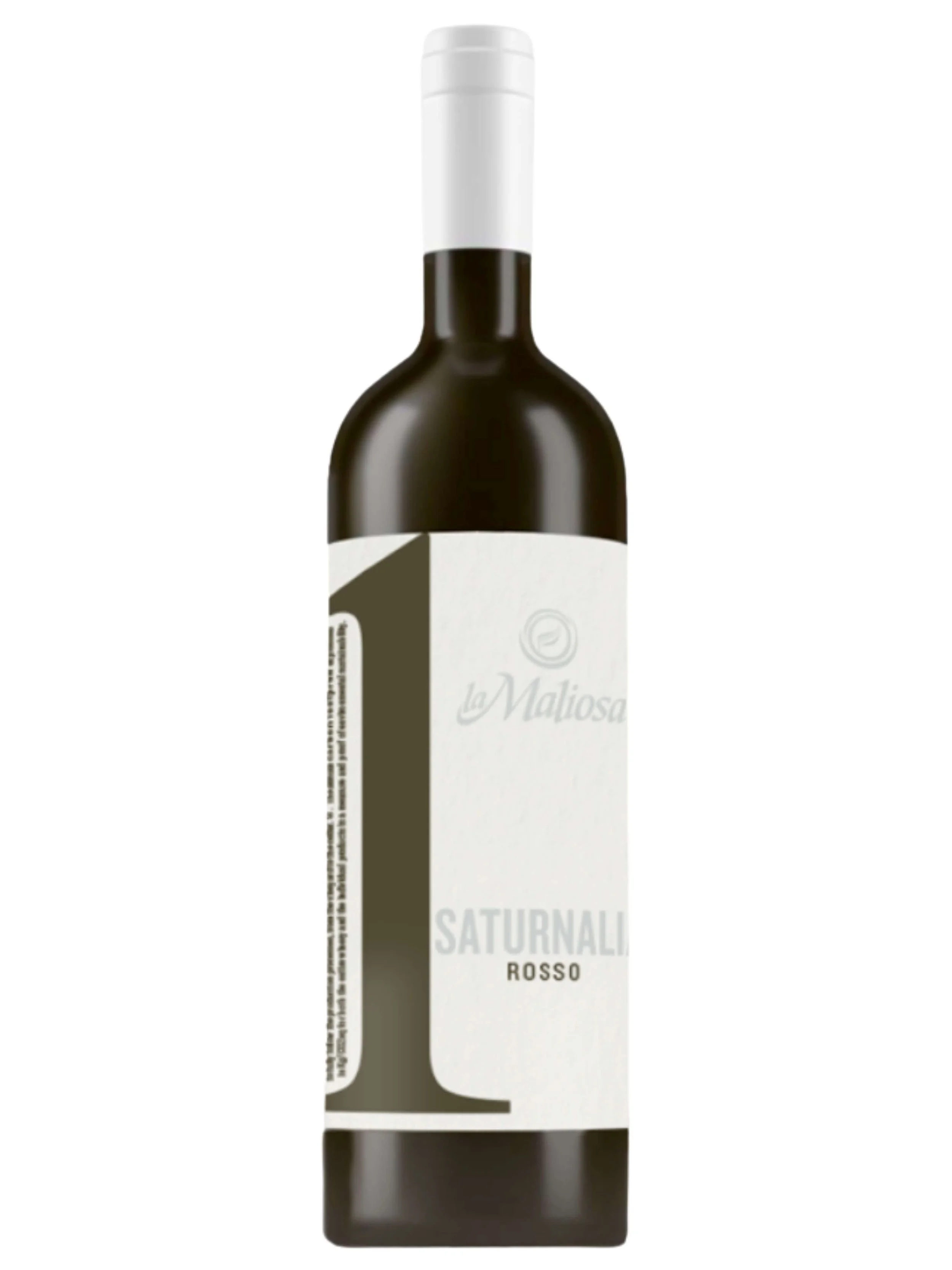
Saturnalia Rosso, once called Saturnia Rosso, is an approachable, balanced red wine with great texture and expressive finish made from a blend of native varieties from central Italy. A four week maceration on the skins is followed by aging in large wooden casks for 20 months. A pretty ruby color is accompanied by cherry and vanilla spice aromas. Pairs great with pork kebabs and cheese burgers. A woman-made organic, biodynamic and vegan natural wine using the patented Metodo Corino which is based on regenerative agriculture farming methods.
Tastes Like: Cherry and Strawberry Fruit Leathers
Farming & Winemaking Highlights: Regenerative Agriculture | Sustainable Winery | Biodynamic | Native Yeast Fermentation | Vegan | No additives (ie non sulphites added) | Unfiltered | Organic | Metodo Corino | Natural Wine
Fun Facts: The natural farming method that produced this wine, the metodo corino, is actually patented by La Maliosa woman winemaker Antonella Manuli after she helped to develop it with natural wine legend Lorenzo Corino of Case Corini.

This wine is a rare treat, being one of the very few Sangiovese red wines grown on volcanic soil. This natural wine is a complex yet approachable. Tarconte is a distinctive old world style natural red wine with a touch of new world, having been aged for 36 months in oak barrels. Notes of earth, mineral, herbs, black pepper, it is super juicy with ripe tannins, a real food wine. A good pairing is with rosemary Asiago cheese. Don't be in a rush to enjoy it: open it and see how it evolves!
Tastes Like: A Baking Spice Cabinet
Farming & Winemaking Highlights: Regenerative Agriculture | Sustainable Winery | Biodynamic | Native Yeast Fermentation | Vegan | No additives (ie non sulphites added) | Unfiltered | Organic | Metodo Corino | Natural Wine
Fun Facts: - The natural farming method that produced this wine, the metodo corino, is actually patented by La Maliosa woman winemaker Antonella Manuli after she helped to develop it with natural wine legend Lorenzo Corino of Case Corini.
- Named after an Etruscan mythological hero.

An award winner in the Millennial Wine Competition, this all natural, fresh and earthy red is made from hard-to-find Tuscan varietal Ciliegiolo whose name derives from cherry - so guess what it tastes like! An organic, biodynamic and natural wine made from the patented Metodo Corino with nothing added but grapes. Made with free run juice, maceration continues for four weeks and then aged in neutral wooden barrels for a short period of time. A natural wine, no sulfites are added during the winemaking process. Cherry and spice aromas and taste with notable tannins and mouth feel contributing to its great structure and long finish.
Tastes Like: Cherry Jam
Farming & Winemaking Highlights: Regenerative Agriculture | Sustainable Winery | Biodynamic | Native Yeast Fermentation | Vegan | No additives (ie non sulphites added) | Unfiltered | Organic | Metodo Corino | Natural Wine
Fun Facts: The natural farming method that produced this wine, the metodo corino, is actually patented by La Maliosa woman winemaker Antonella Manuli after she helped to develop it with natural wine legend Lorenzo Corino of Case Corini.

Earthy, age-worthy nebbiolo made from 70 year old naturally cultivated vines. Named for the dearly beloved grandfather of Lorenzo Corino. Having a garnet color with orange hues it has a complex, spicy nose with notes of cardamom and cinnamon. When tasting, it is fruit forward, cherry & forest fruits, followed by spices, and chalky tannins envelope the mouth and finishes elegantly. After a gentle crushing, fermentation starts with native yeast fermentation and wines are left with skin contact for 6-7 weeks, followed by about 36 mos of aging in wooden barrels.
As with all of Case Corini wines, this is a 00 wine, nothing added, nothing removed, no yeast, no sulphites added, organic, biodynamic, vegan. In other words, all natural wine.

All natural, old vine nebbiolo and barbera blend with no added sulfites and yeast. Aromas of milk chocolate covered cherries, it has a fresh and rich fruity taste with notable tannins and a has a long piquant finish. Name comes from the former owner of the 70 year old vineyard which has a mix of Nebbiolo and Barbera and is down the hill from the childhood home of Lorenzo Corino. After a gentle crushing, fermentation starts with native yeast fermentation and wines are left with skin contact for 6-7 weeks, followed by about 30 months of aging in wooden barrels. As with all of Case Corini wines, this is a 00 wine, nothing added, nothing removed, no yeast, no sulphites added, organic, biodynamic, vegan. In other words, all natural wine.