
Sauvignon Blanc: The Wild Chameleon Grape You Think You Know
“I was at the Merano Wine Festival in 2016, I came across a lot of Sauvignon Blancs to taste. It was then that I had my aha moment with Sauvignon Blanc: each one was intriguingly different from the other.” This experience planted seeds for our sommelier founder, Sheila Donohue, to explore the sauvignon blanc grape and the myriad of wine styles it makes.
For many, the taste profile that comes to mind when asked about Sauvignon Blanc are the pungent green and grassy notes, thanks to the proliferation of New Zealand Sauvignon Blanc that helped catapult Sauvignon Blanc in popularity in the US. But, as we know with other wines that get super popular in the US, think Lambrusco and Prosecco, there is a dark side to a wine category once this happens: a wine gets “boxed in,” meaning a general opinion gets formed assuming a category of wine always has that certain taste, style and level of quality.
Unfortunately, 99% of the time in the world of wine, these are incorrect assumptions. Take Sancerre Sauvignon Blanc, for example: the intense “green” aromatics of a typical New Zealand Sauvignon Blanc contrasts with the more subtle, mineral driven “Old World” Sauvignon Blancs of Sancerre, in which the latter offers complex and unexpected notes such as ‘cat pee’ aromas. Practically, it’s a completely different wine.
But, even so, if you were to compare Sauvignon Blanc vs Pinot Grigio, most of the time Pinot Grigio is a straight shooter when it comes to taste, meaning it’s quite predictable. While a Sauvignon Blanc wine’s taste could really surprise you if you venture out and explore different types.
In fact, Sauvignon Blanc could be the most misunderstood wine grape in the world.
To peel the onion on Sauvignon Blanc, we talked to the first line of defense, Sauvignon Blanc winemakers, to find out their take on the grape both in the vineyard and in the wine cellar.
Sauvignon Blanc, the Grape

A just harvested sauvignon blanc grape cluster.
The sauvignon blanc grape itself is fundamental to wine heritage as we know it today, being the parent of cabernet sauvignon, as well as on its own being “solely responsible for some of the world’s most distinctively aromatic dry white wines.” according to Jancis Robinson’s The Oxford Companion to Wine. Originating in Bordeaux, the name of sauvignon blanc comes from sauvage which means wild in French, which, according to Karen MacNeil’s Wine Bible is due to it being a very vigorous vine, growing like a wild plant.
What is it about the sauvignon blanc grape that it can produce such a wide arrange of styles?
We got first hand perspectives talking with some Vero producers who are out in the vineyards cultivating sauvignon blanc and making it into wine.
According to them, there 3 principal aspects which influence greatly the style of Sauvignon wine the grapes will create:
· the soil, geography, altitude, and all other aspects which are encapsuled in the concept of terroir,
· time of harvest,
· canopy management in the vineyard.
Let’s explore each of these factors with winemakers and vignerons who work with the grape:
Terroir for Sauvignon Blanc in Friuli, Austria and Czech Republic
The 3 winemakers we spoke with about Sauvignon Blanc are in:
Friuli, Italy,
South Styria, Austria,
Znojmo in Moravia, Czechia.
And, really, all 3 of these estates are not far from one another, yet they all are in different countries:
If you start from Vigna Petrussa’s estate in north eastern Italy in Friuli, right on the Slovenian border, and you cross Slovenia diagonally in a north east direction…
you get to Michi Lorenz’ estate in South Styria, Austria, also right next to the Slovenia border, but this time north of Slovenia. Then head north 3 hours from Michi Lorenz, traveling through Austria…
you get to Thaya estate winery right after crossing the border to the Czech Republic.
One common element of these 3 wine producers, aside from them all making expressive Sauvignon Blanc wines, is that they have, in general, common climate characteristics, since they are all farther north in Europe. They all have cooler, more wet, weather conditions and experience wider daily temperature ranges, known as diurnal fluctuation.
Terroir of South Styria Austria for Sauvignon Blanc

Michi Lorenz after just harvesting sauvignon blanc in his South Styria vineyards.
Michi Lorenz is in Südsteiermark, or South Steiermark, a subzone of the Styria wine region, known for some of the best Sauvignon Blanc wines in the world, as we covered in this blog article. Steiermark is German for Styria so the area is also known as South Styria.
Asked why Südsteiermark is known for noteworthy Sauvignon Blancs, Michi says it’s because of the climate: being closer to the sea, compared to subzones north of him, his vineyards have accentuated diurnal variation. These large swings of temperature in 24 hours, ranging between cold and warm temperatures, help the grape to mature while retaining its acidity, allowing the fruit and sugars to develop and mature to create a balanced wine. He said that they also get more rain compared to other Sauvignon Blanc wine regions; in fact Südsteiermark is known as the ‘Green Tuscany’ for its beautiful green hilly landscapes. Michi Lorenz’ property also has a higher altitude then most wineries in this area, over 2000 feet above sea level.
Terroir for Sauvignon Blanc in Moravia, Czech Republic
The Czech Republic is slowing becoming a shining star of an up and coming wine region. We spoke with Thaya’s winemaker Jakub Smrcka, in the city of Znojmo, in Moravia, the southern region of Czechia, just north of Austria, about growing and making Sauvignon Blanc in his area. Thaya is located between the river Thaya and a National Park, an area blessed with many microclimates. They also have great soil for making wine, especially white wines: Jakub said that all of their sauvignon blanc vineyards are grown on granite soil, a conscious decision to drive minerality and herbal characteristics into the wine, so fruit takes second stage.
Sauvignon Blanc Terroir in Friuli Italy
Sauvignon Blanc in Fruili, Northern Italy, is a “newcomer” to their wine region. It was about 30 years ago that some Sauvignon Blanc wines from this northern easternmost region of Italy received noteworthy international prizes, after which the terroir of Friuli was determined a great one for Sauvignon Blanc. Vigna Petrussa based, in central-east Friuli, near the Slovenian border, has, like Michi Lorenz’ estate, a diurnal influence with large temperature swings which is great for white wine grapes, like sauvignon blanc.
Timing the Harvest for Sauvignon Blanc
When to harvest each sauvignon blanc vineyard is a critical decision, since when you pick can result in very different Sauvignon Blanc wines, with different aromas and flavors. Even year by year, the grapes can produce different wines.
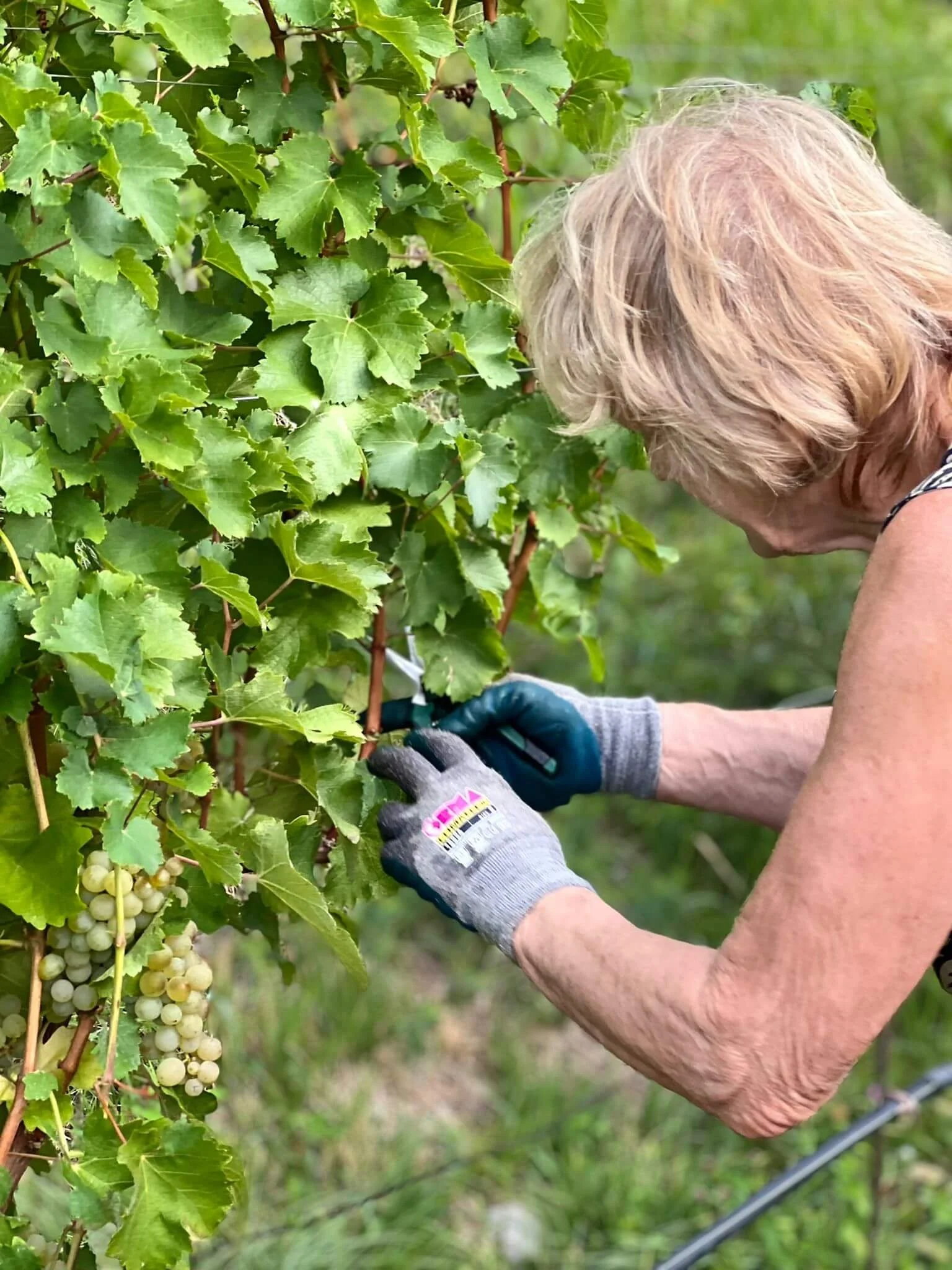
Hilde Petrussa harvesting sauvignon blanc grapes in Friuli Italy.
For example, with Michi Lorenz’ Sauvignon Blanc Klassik, he prefers a “green and fruity” style, so he harvests those grapes sooner compared to his other Sauvignon Blancs. On the opposite side of the spectrum is his Halo Sauvignon Blanc Orange Wine, where he does a late harvest “playing poker,” as he calls it since waiting to harvest is a win/lose game. Then, his Schist Happens Sauvignon Blanc has a mix of early, mid, and late harvest grapes, even combining different vintages together to create a unique profile of a Sauvignon Blanc wine.
Also at Thaya in Moravia, they do multiple harvests of Sauvignon Blanc, doing multiple harvests of the same vineyard and then keeping each harvest separate in the wine cellar by vinifying each separately in different tanks.
Hilde Petrussa, the second generation woman owner and vigneron of Vigna Petrussa , like Michi Lorenz, also cites the large variations year by year, showing how sensitive the grape is to climate differences. She chooses to harvest when the fruit is more mature, favoring aromas and a creamy mouthfeel over a more acidic, vertical style.
Canopy Management
Lastly, vineyard practices, like canopy management, will also influence a Sauvignon Blanc wine’s characteristics, as well with many other wines grapes.
At Thaya, winemaker Jakub Smrcka, in hot vintages, like this year, he wants leaves to cover the grapes so to allow the grape to maintain acidity and prevent burning the grapes from the sun and excessive heat. Otherwise in colder, wetter years, like in 2025, they thinned the leaves to allow for more air flow and to prevent powdery mildew.
Likewise, just south of Thaya in South Styria, the sauvignon blanc vine grows a lot. Mich Lorenz admits to investing a lot of time in the vineyard to work the leaves on his Sauvignon Blanc wines especially.
Hilde Petrussa of Vigna Petrussa says the sauvignon grape is delicate, with a thin skin, so the abundant growth of the plant is like a natural protection for the grape, since the leaves are needed to protect the fragile grapes. Plus with leaf coverage, it helps to allow the aromatic molecules to properly develop in the grape. Fun fact: in Friuli, where Hilde Petrussa is from, they call the wine ‘Sauvignon’ without blanc as an abbreviation for Sauvignon Blanc.
Sauvignon Blanc, the Wine
Jancis Robinson in her The Oxford Companion to Wine mentions with sauvignon blanc wine what’s ‘‘most recognizable is its piercing aroma.” Karen MacNeil in the Wine Bible seconds that with a more colorful commentary in line with the sauvage or wild theme, writing “Riotous can…describe sauvignon’s flavors. These are not nicely tamed tastes.”
Let’s see what each of these 3 winemakers, Michi Lorenz, Jakub Smrcka and Hilde Petrussa, have to say about working with Sauvignon Blanc in the wine cellar.
What Michi Lorenz has to say about South Styria Sauvignon Blanc

Michi Lorenz smelling the aromas of his just crushed sauvignon blanc grapes.
“You can make an extreme fruity or extreme spicy sauvignon blanc. A lot depends on how you work with the terroir,” says Michi Lorenz. Crafting the wine starts with the vineyards. “Sauvignon Blanc styles can have extreme ranges from green pepper to cassis and elderberry, most of which is determined by when you decide to harvest,” Michi explains.
His Sauvignon Blanc ranges from:
what he calls “Klassik” that despite its name, because it was made by 3 harvests, an early, mid and late, it has citrus and apple flavors with a hint of lemongrass.
Schists Happens, a call out to the soil, is a unique non vintage Sauvignon Blanc made from 4 vintages and across 9 different vineyards using the solera method resulting in a wine that screams minerality and transforms incredibly after you open it.
On the contrary, Halo is a single vineyard skin contact orange wine made from the highest altitude sauvignon blanc vineyard that Michi has. Having a reductive style, it tastes like a freshly picked mandarin orange with incredible complexity, salinity and mouthfeel.
Sauvignon Blancs from Moravia, Czechia
Thaya winemaker Jakub Smrcka says that the style of wines that he makes are similar to that of South Styria, higher acidity, reductive and fruit.
Also like Michi Lorenz in South Styria, the different harvest times influence Jakub’s winemaking by crafting different styles of Sauvignon Blanc. As mentioned earlier, Jakub vinifies each Sauvignon harvest separately, having up to 10 separate vats, each harvested at a different time and some from different vineyards as well. Then he examines the turbidity of the must, to see how much sediment is in it, eg if it has more sediment, it is cloudy in appearance, like an unfiltered wine or a wine on its lees. If you want more fruit in the Sauvignon Blanc, he chooses must that is clear looking, then if he wants a more reductive, mineral driven Sauvignon Blanc, he uses a batch of must with high amount of turbidity, or cloudiness. Then he blends together these separately vinified batches to make Thaya’s wide selection of Sauvignon Blancs.
A fruit forward Sauvigon Blanc that Thaya makes is their steel aged National Park Sauvignon Blanc, with lime and salinity dominating the flavor
One of the newest Sauvignon Blancs that Thaya makes is one with the Znojmo VOC appellation, the first wine appellation in the Czech Republic. Their Sauvignon Blanc that has this Znojmo appellation is one that is more reductive and minerally, and is also age worthy, a true expression of the local Znojmo terroir.
Then, Thaya makes an oak aged Sauvignon Blanc that has ripe fruit and secondary flavors thanks to its oak aging and maloactic fermentation. This Sauvignon Blanc a completely different profile than the previous two steel aged Sauvignon Blancs by Thaya, with another dimension of flavors and aromas. Its taste ranges from poblano chili peppers to grapefruit pith, and even has aromas of walking into a coffee roaster shop. It’s a really intriguing Sauvignon Blanc. .
What Hilde Petrussa of Vigna Petrussa has to say about Sauvignon Blanc from Friuli
Sauvignon Blanc is the first of all grapes that are harvested at Vigna Petrussa. Hilde Petrussa prefers her Sauvignon Blanc wine to be less grassy and more floral, even though herbal notes, like tomato leaves, are still ever-present in her Sauvignon wine.
Sauvignon Blanc Food Pairing
Reading these descriptions of sauvignon blanc flavors must be whetting your appetite! So, naturally, we asked all 3 winemakers, Michi, Jakub and Hilde, which food pairings they recommend with Sauvignon Blanc.
The first thing Jakub thought of when speaking of his Thaya Znojmo VOC Sauvignon Blanc was pairing it with fish, in fact trout, which is also a local fish that comes from the river Thaya.
Michi, having a range of different types of Sauvignon Blanc wine styles, recommends different dishes for his different Sauvignon Blancs, with the exception of seafood which pairs with all 3 of his Sauvignon Blancs that we carry. With his Sauvignon Blanc Klassik, he suggests pairing it with cold appetizer dishes. For his Schist Happens Sauvignon Blanc he suggests white meat dishes, while for his Halo Sauvignon Blanc Orange Wine he recommends duck meat dishes.
Is Sauvignon Blanc dry? Yes, it is. Yet, Hilde admits that pairing Sauvignon Blanc wine with food is not so easy. The food dish needs to have some structure, like, for example, a risotto: it should have a flavorful vegetable, like pepper, tomato or asparagus so the risotto dish flavors stand up to the flavor intensity of the Sauvignon Blanc wine. She also recommends pairing egg dishes with Sauvignon Blanc (hey - that’s a great idea for a brunch wine!)
Ready to Discover your Next Favorite Sauvignon Blanc?
If you’re like us, you like to explore the best Sauv Blanc wine and to compare and contrast. Which is why we offer an array of Sauvignon Blancs from different styles and places all made by artisanal wine estates. Vero specializes in farm to glass wines made by small producers who are ripe for discovery, like Michi’s, Jakub’s and Hilde’s Sauvignon Blancs.
We sell to business and consumers across the US where you can exercise and excite your pallet with expressive flavors of wines, olive oils and specialty foods.
If you work in the industry, contact us to get pricing and arrange a tasting of these fabulous sauvignon blancs.
If you are a wine explorer seeking to expand your palate and portfolio, you can also purchase these wines from us online and we ship to you. Buy this Sauvignon Blanc Explorer Set of 3 different types from these producers and places we talked about in this article. If you are a “hooked” on wine discovery, join our award winning wine club for new surprises every month or quarter.
We also personalize gifts and wine tasting events for your loved ones and business colleages and clients. Contact us to learn more.
Try An Array of Sauvignon Blanc Wines

With its subtle greenish color, this wine immediately offers an aroma of typical grassy blackcurrant leaf. On the palate, it's fresh, light, and direct, echoing the blackcurrant twig before concluding with a persistent mineral finish. From a winery called “Best in the Czech Republic” for multiple years in a row, this wine is farmed organically in a local national park.
Tastes Like: Herbaceous and grassy limes
Farming & Winemaking Highlights: Regenerative Agriculture | Sustainable Winery | Organic
Fun Facts: The fish on this label is one that is found in the river that runs through the national park where these grapes are farmed.

Lovely classic Sauvignon Blanc flavors of tomato leaf and citrus fruits burst out of the glass. This is a complex, yet approachable unoaked Sauvignon Blanc from a winery called “Best in the Czech Republic” for multiple years in a row.
Tastes Like: Lemon lime citrus with salt
Farming & Winemaking Highlights: Regenerative Agriculture | Sustainable Winery | Organic
Fun Facts: This Sauvignon Blanc is part of the first appellation in the Czech Republic, VOC Znojmo.
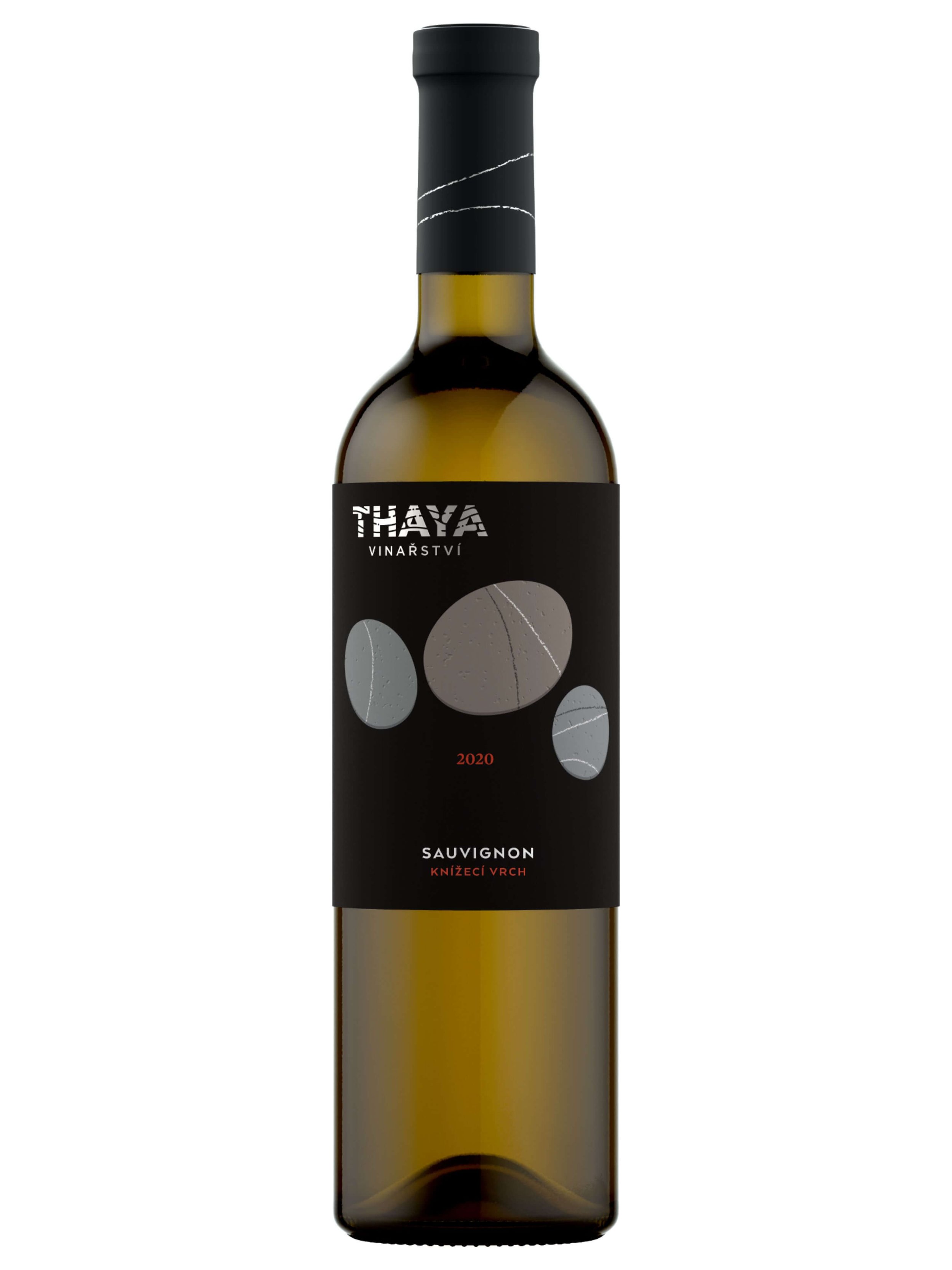
From the Thaya estate winery in the Czech Republic, sipping this late harvest sauvignon blanc is like having a lemon creamsicle as a white wine.
It has an intriguing nose, floral, with cape gooseberry fruit and lemongrass, thanks to aging in french oak barrels for 12 months, of which 20% is new oak. It has great acidity with flavors of lemon and poblano chiles mixed in with a creamy taste and mouthfeel and a long, saline finish.

Coming from an area known for some of the best Sauvignon Blancs in the world, in the Südsteiermark subzone of in the South Styria of Austria, at 400m altitude with hand picked harvesting, this lemon yellow color sauvignon blanc has an intense bouquet of lemon, lemongrass and flint. It has citrus and apple flavors with a hint of lemongrass. It has great acidity and a long, sapid finish. Soils are red schist and loam. After 24 hours of skin maceration, the fruit was fermented with native yeast and aged in stainless steel. Minimal sulfur additions.

Straw yellow with bright green hues, lingering and vibrant bouquet recalling white peach, sage and tomato leaf. Ian D'Agata who cites Vigna Petrussa as ‘one of the best estates in Italy’ describes this wine as ' a less overtly green Sauvignon Blanc than most people are accustomed too, but offers plenty of refinement and sneaky concentration.'
Vigna Petrussa is a certified sustainable and biodiverse women-owned winery.

This unfiltered sauvignon blanc natural wine is playfully named after the limestone, mineral-rich soil where it was cultivated. It’s from the Sudsteiermark, or South Styria, Austria, known for some of the best sauvignon blanc in the world. It has a bright lemon yellow color with an intense reductive nose that has curious complex aromas that develop more once it breaths, such as tropical fruit aromas. The taste has a 'wow' factor with racy, prickly acidity, really nice texture a VERY long mineral finish. Think of what it’s like to lick a rock - this is it! This is your ‘atypical’ Sauvignon blanc, made from a mix of 9 different Michi Lorenz’s estate vineyards, some early, mid and late harvests, and across 4 different vintages using the complex solera method. A real one-of-a-kind sauvignon blanc.
A natural, and certified organic and biodynamic wine made with native yeast fermentation.
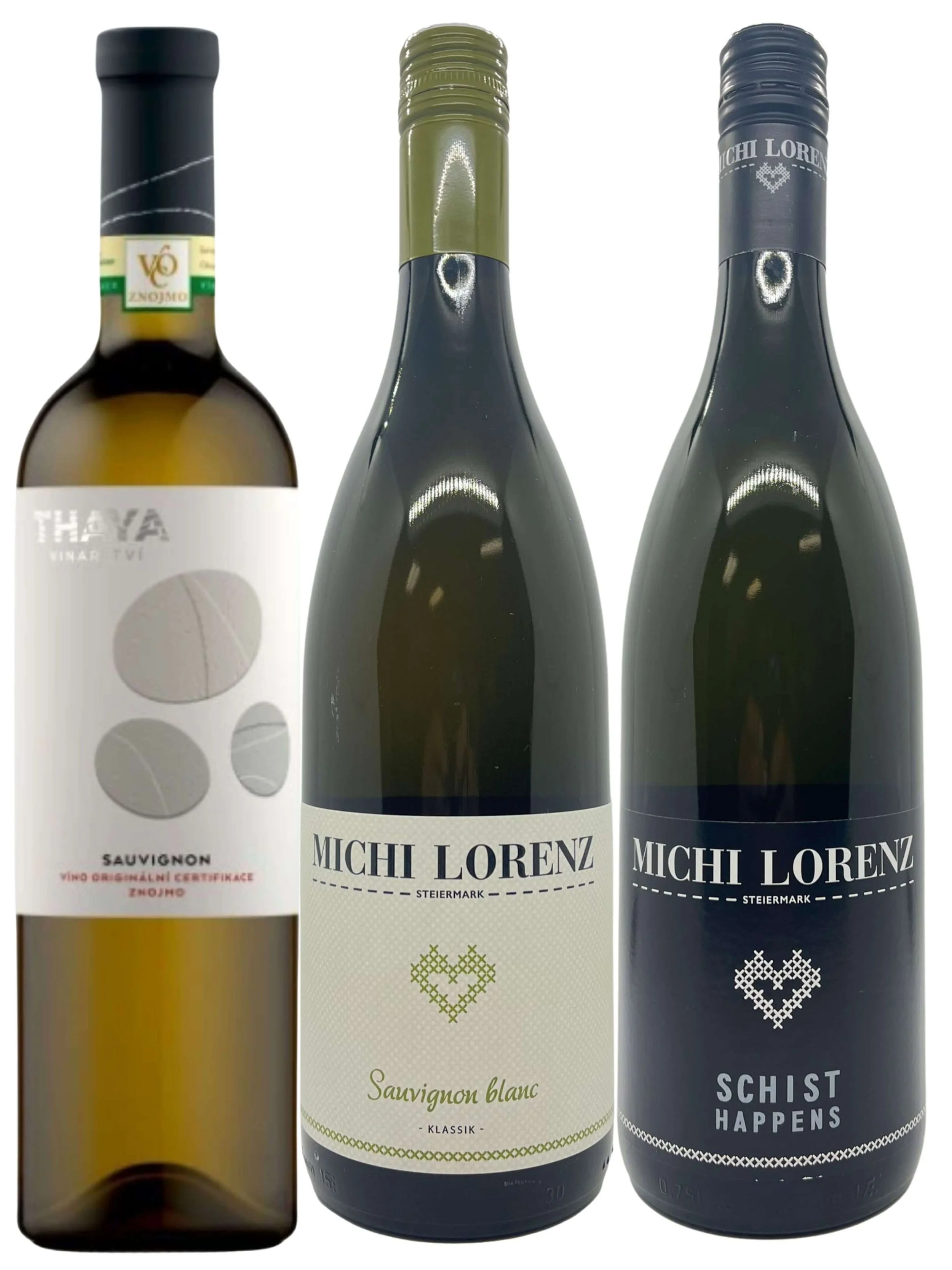
Try Sauvignon Blanc like you never had before in this exclusive 3 pack gift set of unique farm-to-glass Sauvignon Blanc wines.
This wine gift basket includes Sauvignon Blancs from Northern Europe, some of the best places in the world for Sauvignon Blanc. These 2 are from South Styria, Austria, which show the winemaker, Michi Lorenz' prowess in crafting an amazingly complex natural wines:
and a non vintage Sauvignon Blanc made with the solaris method and coming from 9 different vineyards and 4 vintages, a nothing added natural wine.
- and it includes a Sauvignon Blanc from Znojmo, in Moravia, Czechia.
This gift set is made for a Sauvignon Blanc lover: it's a great way to discover different styles of Sauvignon Blanc!
Shipping is included in the Continental US.

Cloudy mandarin orange color late harvest Sauvignon Blanc natural wine from one the best places in the world for Sauvignon Blanc leads to a saline and yeasty nose with a bit of lemongrass notes. It has laser-like, linear acidity and is super tasty, with great fruit and salinity. It is a 'meaty' orange wine with nice mouthfeel and slight tannins. This Sauvignon Blanc is from the Sudsteiermark region of Austria in South Styria.
This skin-contact orange wine is crafted with native yeast fermentation by certified organic and biodynamic Austrian winery Michi Lorenz.