
Rockstar Sauvignon Blanc from Austria’s South Styria
As a young man growing up in a winemaking family in a beautiful and picturesque grape-growing region in Austria, Michi Lorenz had a dream, as many young men do, to become a rock star. Music was his passion. But with a 500 year history in his family of making wine on his family’s property, having parents who were looking to “pass on” their vineyards and winery to their children, and with his own love of wine and wine culture, Michi realized that his destiny wasn’t to be on a stage at an international music festival. At least, not yet. His imminent future stage would look a little different.
His “melodies” would be from the natural rhythm of the vineyard cycle, his “movements” from the rushing noises of harvest, and, his commitment to producing natural wine would rise like a crescendo with the resulting wines creating a perfect pitch.
Several years later, he’s made it to that worldwide stage, with a glass in hand as a trailblazer for the “natural wine” movement in Austria.
We were inspired as we talked and tasted with Michi Lorenz at our VeroTalk with him. Here are the highlights of what we learned about him, his family, his land and his wines.
Deep Roots in South Styria/Südsteiermark

South Styrian winemaker Michi Lorenz
His family’s property in the Styria region of Austria, aka Steiermark, have vines planted since 1524. In fact, in 1524 it was recorded that Farmer Lorenz paid his taxes with his wine.
Meanwhile, it was really his grandfather who turned the vineyards and winery into an actual business shortly after World War II. Michi’s father followed suit but concentrated on red wines whereas Michi himself currently produces more white wines. After talking with Michi, he seemed to accept that with global warming upon us more red wines might be forthcoming but for now, and certainly many years into the future, white wine will be his mainstay.
And, natural, organic, and biodynamic wines, are his passion.
Which is why he is in the perfect region to produce such wines.
Austria is a landlocked country with mostly a continental climate due to the high alps in the West and with much of its vineyards situated on the Pannonian plains of Central Europe to the North and East. While Styria is a rather small wine producing district with only 5109 hectares (12,625 acres), it does rank, though, as Austria’s 3rd largest wine producing area and Austria’s most famous Sauvignon Blanc producing region, making some of the best Sauvignon Blancs in the world.
The vineyards Michi’s family has worked and owned for centuries lie in the southernmost wine region in Austria known as South Styria, or Südsteiermark in German, which borders Northern Slovenia. This region is hilly and has some smaller mountains, what Californians would call “foothills”.
South Styria Terroir

Michi’s house, perched on the top of an Austrian hillside, graced by his “vertical” vineyards.
Thanks to Michi’s foresight to shift his family winery focus from red wines to white wines, we have the opportunity to explore the full depth of Sauvignon Blancs from South Styria.
Why is South Styria so good at producing Sauvignon Blanc wine?
In this Styrian South, vineyards are influenced by a more Mediterranean or “temperate” climate as the Adriatic Sea is a mere 198 miles away. Michi’s vineyards are located in Kitzeck in Sausal which has the highest peaks in the region and his vineyards are all 620 meters above sea-level (2034 feet), and he is a small winery making approximately 50,000 bottles a year. Some of his vineyards are south facing slopes and literally vertical – reminiscent of the very vertical slopes adjacent to the rivers in Germany. According to Michi, “our vineyards get plenty of rain and the difference during the growing season between the daytime high and the nighttime low is significant which allows our grapes to get ripe but still maintain beautiful acidity”.
The soils in his vineyards are variables of slate/schist – grey schist, red schist and black schist; each adds a different character to the scents and flavors of the grapes, and thus the wines, from beautiful acidity to this unusual but lovey smokiness. We only tasted four of his wines but the terroir of this region came through without hesitation. In fact, his tongue in cheek Schist Happens Sauvignon Blanc is a call out to the soil which crafts this incredible Sauvignon Blanc crafted from 9 different vineyards and 4 different vintages.
Do Biodynamic Wines Taste Better?
Producing Demeter, or biodynamic wines, isn’t easy in Austria as, according to Michi, because it has the strictest biodynamic laws in the wine world.
But Michi is a believer, as he has seen the positive effect and the difference in his grapes in the short time he has been certified. Prior to the Demeter certification, since the year 2003, Michi was doing as much as he could, in the vineyards and winery, to be organic and biodynamic. He was finally able to move the vineyards to 100% organic and biodynamic with the vintages of 2020, 2021 and 2022; according to Michi, “grapes from these vintages were the best I have ever seen”.
To have a vineyard farmed biodynamic requires a lot more time for the winemaker or vineyard manager to have boots on the ground and hands in the vineyard. Without the use of pesticides and the like, winemakers and vineyard managers need to be proactive to prevent pests, to deal with weeds and to thwart fungus.
Without the use of anything artificial, a huge emphasis has to be placed on canopy management. In order to prevent mildew from growing on the leaves and grapes in the vineyard after a rain, leaves might need to be thinned. To keep those same grapes from getting sunburned, the leaves might need gentle hands to rearrange their growth projection. With more time spent in the biodynamic vineyard than might be the case for a commercial vineyard, the winemaker, or vineyardist, is going to become more aware of all the potential issues to their vines. Basically, more acute attention to the vineyard keeps the majority of the problems away without the use of chemicals. Michi is well aware of the patience and time required to farm biodynamic and is convinced that his extra effort is paying off in his wines.
Sauvignon Blanc Made with “Attention but not Interference”

One of Michi’s Sauvignon Blanc vineyards.
His patience comes through at harvest as well. Most vignerons will choose the best overall time to pick the grapes in a specific vineyard, averaging out the grapes that are too ripe with the grapes that are not yet fully developed and hoping that the majority of grapes are at their perfect maturity. Michi, however, takes the time to make three passes through his vineyards picking only the mature grapes on each pass. Thus, the resulting wines express more of the true “terroir” of his vineyards as more of his grapes are brought in at their perfect physical and physiological ripeness.
That same intense attention given to the vineyards is required in the winery to make natural wine. Attention but not interference. Natural wine producers truly try to let the grapes and their natural yeast “go it alone”. Rather than interfere, they “accompany” the must as it begins to ferment and create wine. Michi’s wines are made with the natural yeast from his vineyards, in other words, his wines are not inoculated with commercial yeast. Michi uses the bare minimum of sulfur – mainly relying on the sulfur that already exists in the environment. Most large scale commercially made wines range from 150 to 180 mg/L of sulfur but his wines are under 50 mg/L with most coming in at 10 mg/L, which is the typical range for a winemaker that does not add sulfites.
According to Austrian law, if you write “natural wine” on your wine label, you cannot indicate the name of the vineyard. So, Michi has had to create proprietary names for each wine, something that doesn’t seem to have been difficult for him. After having interviewed him for less than an hour during our VeroTalk with him, it was quite obvious that this winemaker has a creative and dynamic personality. His personality comes across in the names he’s given his wines. They are fun and apropos.

Michi with a cluster of his freshly picked sauvignon blanc grapes.
Then he told us the sweet story that goes along with embroidered heart on the label. Rather than go with a traditional Austrian wine label, typically a drawing of the winery and verbiage, or a more American cultural label, in Michi’s case, a rock star perhaps, he chose the embroidered heart which is culturally recognizable from Austria and seems endear to him. It wouldn’t surprise us though if in the future some of his wines have a rock star theme.
A Rock Star Wine Tasting
Sommelier Roxanne Langer guided us through the wine tasting of Michi’s wines during our VeroTalk with him.
She comments “Having interviewed 100’s of winemakers in my career, Michi was the first to use a musical simile to describe the yearly wine vintage.” In fact, Michi said very fervently, “it’s as though I’m releasing a new album every year”.
With guitars within arm’s reach in every room in his house and cellar, his passion plays on in his wines. He’s a rock star winemaker who may someday be on a stage with both a wine glass and a guitar.
Sauvignon Blanc Klassik, Made From 3 Harvests
Michi: “This Sauvignon Blanc I call Klassik because it is ‘my version’ of a classic Sauvignon Blanc: I make it by doing early, mid and late harvests, allowing it to deviate from a typical Sauvignon Blanc style that you may be familiar with.”
Roxanne: “Slightly smoky on the nose with herbaceous and green fruit. Palate amplifies the green fruit with green apple, soft lime and minerality. Long finish, easy to drink with lots of character. This would be a great wine to serve with the more difficult vegetable pairings such as asparagus and artichokes, even salads with non-creamy dressings.”
Schist Happens, a Non Vintage Solera Style Sauvignon Blanc
Michi: “This wine is non-vintage and includes wine from the several vintages as well as the current vintage and has some skin contact. The varietal is Sauvignon blanc but the idea was not to produce a varietal “Sauvignon blanc” but rather a solera style non-vintage wine. With this wine, it is much more important to me to show the terroir of the region. Both stainless steel and barrel ferments but only 20% of the latter in neutral oak. Reminds me of Pink Floyd.”
Roxanne: “Smoky on the nose with more complex scents than the Klassik. More golden color due to the solera influence. Very minerally on the attack but slowly moves to fruitiness. Great acidity even with the blended older vintages. Nice medium length finish.”
Halo, a Single Vineyard Sauvignon Blanc Orange Wine

The ‘Halo’ of light from a local church that inspired the name of Michi’s orange wine.
Michi: “The name came from a view from the vineyard of our village church up on a hill. One evening I was in the vineyard and the moon was out and I could see the church upward in the distance and it had this incredible “halo” light-with-fog effect over the top of the steeple. I knew at the moment what I would be naming the wine!”
Roxanne: “The nose is reductive with more fruits and herbs. The palate is intense with layers of dried fruit and green floral. Beautiful long finish. I think this wine should be decanted or at least swirled frequently in the glass as its scents and flavors change with each swirl.”
Michi: “A lot of surprises in this wine, sometimes in your face but in the end you will say it is amazing! Only 11.9% alcohol but great long finish. This wine reminds me of David Bowie: lots of suprising things yet amazing.”
Zweigelt
Roxanne: “Beautiful smokiness (from the soils) on the nose with concentrated red fruit in fact, very fruit driven.
On the palate, cranberry, deep red cherry, spiciness, slight back pepper but ends with a white pepper finish. Would pair well with both pork and meat dishes and perfectly with duck and a cherry compote.”
Michi: “As with all my wines, the Zweigelt has a bit vibration on the tongue which comes from the minerality of the schist soils.”
Where Can You Buy Michi Lorenz Wines in the USA?
We are thrilled to have discovered Michi Lorenz and to have been the first to import his organic and biodynamic wines to the USA. We sell them to businesses and consumers across the US. Buy his wines online here. If you work in the wine trade, contact us to taste his wines and get pricing.
This article is written by sommelier Roxanne Langer, founder of Lady Somm wine consultancy and the Carmel Wine School.
Try The Rock Star Natural Wines of Michi Lorenz

Coming from an area known for some of the best Sauvignon Blancs in the world, in the Südsteiermark subzone of in the South Styria of Austria, at 400m altitude with hand picked harvesting, this lemon yellow color sauvignon blanc has an intense bouquet of lemon, lemongrass and flint. It has citrus and apple flavors with a hint of lemongrass. It has great acidity and a long, sapid finish. Soils are red schist and loam. After 24 hours of skin maceration, the fruit was fermented with native yeast and aged in stainless steel. Minimal sulfur additions.

This unfiltered sauvignon blanc natural wine is playfully named after the limestone, mineral-rich soil where it was cultivated. It’s from the Sudsteiermark, or South Styria, Austria, known for some of the best sauvignon blanc in the world. It has a bright lemon yellow color with an intense reductive nose that has curious complex aromas that develop more once it breaths, such as tropical fruit aromas. The taste has a 'wow' factor with racy, prickly acidity, really nice texture a VERY long mineral finish. Think of what it’s like to lick a rock - this is it! This is your ‘atypical’ Sauvignon blanc, made from a mix of 9 different Michi Lorenz’s estate vineyards, some early, mid and late harvests, and across 4 different vintages using the complex solera method. A real one-of-a-kind sauvignon blanc.
A natural, and certified organic and biodynamic wine made with native yeast fermentation.

Cloudy mandarin orange color late harvest Sauvignon Blanc natural wine from one the best places in the world for Sauvignon Blanc leads to a saline and yeasty nose with a bit of lemongrass notes. It has laser-like, linear acidity and is super tasty, with great fruit and salinity. It is a 'meaty' orange wine with nice mouthfeel and slight tannins. This Sauvignon Blanc is from the Sudsteiermark region of Austria in South Styria.
This skin-contact orange wine is crafted with native yeast fermentation by certified organic and biodynamic Austrian winery Michi Lorenz.
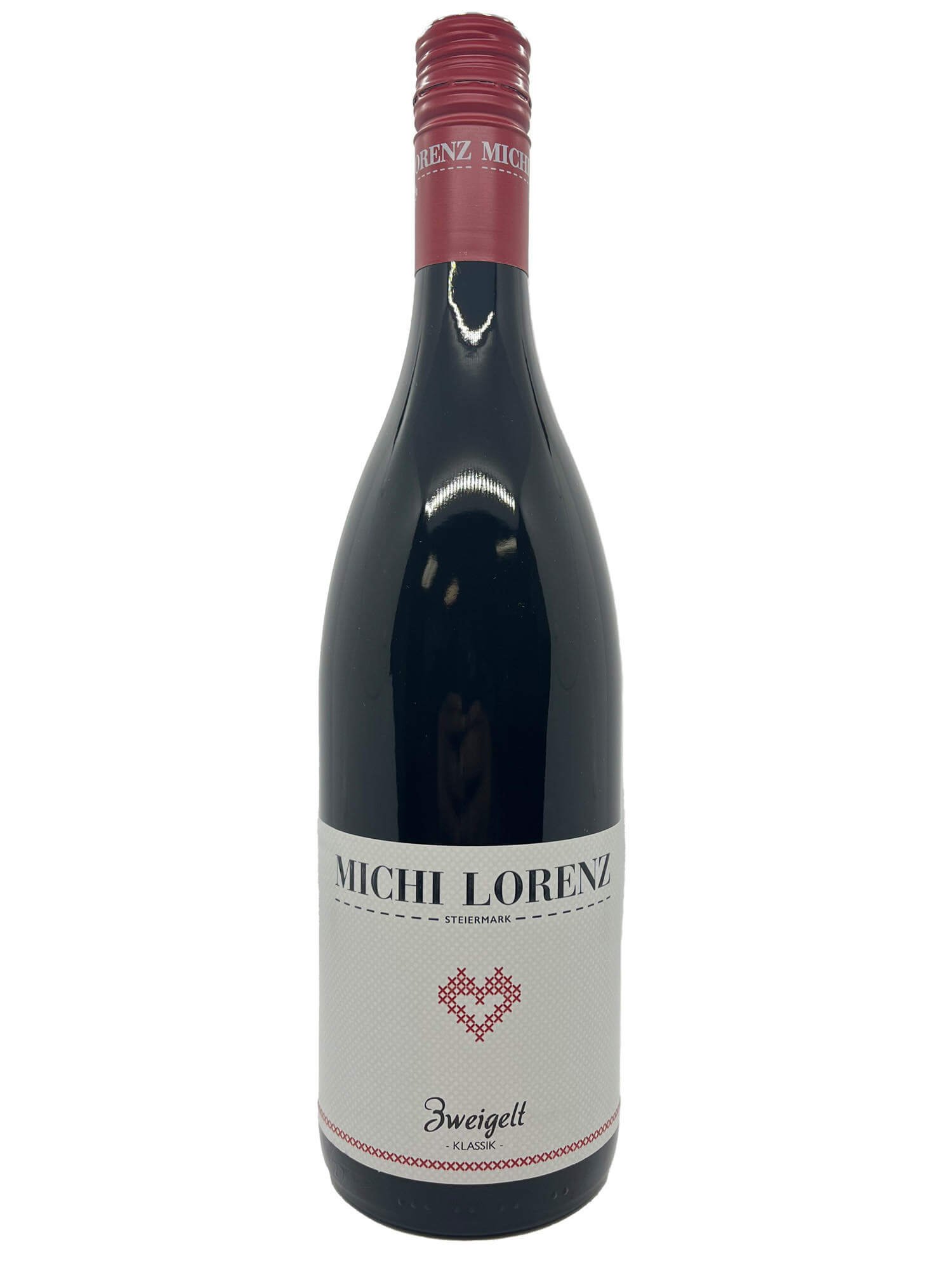
The organic and biodynamically farmed fruit was handpicked from estate hillside vineyards 400 meters above sea level in Sausal. Soils are red schist and loam. The wine underwent native yeast fermentation. After 25 days of maceration on the skins, the wine aged in a combination of stainless-steel tanks and oak barrels with very minimal sulfites added.
The first sniff of this quaffable Zweigelt natural wine is amarena cherries which then leads to vanilla and spice. In the mouth it is fresh with fruit that hides behind the structure and chalky tannins. It has nice texture and a medium slightly bitter finish. It is easy drinking and pairs great with hamburgers.