Mardi Gras and Carnival: Connecting Traditions Around the World
Bright colors, fancy masks, indulgence. These are what a lot of people consider the hallmarks of Mardi Gras, and of Carnival as well. But wait what’s the difference… aren’t they the same? Well, technically no. So let’s dive into the history legends, traditions, and of course, foods to understand where Mardi Gras and Carnival come from… and how to celebrate both!
Carnival, or carnevale as it is called in Italian, is the season between the Epiphany (January 6th) and the beginning of Lent (the 40 days before Easter). It is marked by festivals, parties, and various religious events, and culminates in the famous Mardi Gras, Fat Tuesday, or martedi grasso in Italian. Mardi Gras is the last Tuesday before Lent begins, on Ash Wednesday. As Lent is traditionally a period of religious observation marked by abstinence of some kind for 40 days, Mardi Gras is the opportunity to get your fill and enjoy every moment of indulgence before the strictness of Lent. None other than Edgar Allen Poe says it best in his short story The Cask of Amontillado, that takes place “one evening during the supreme madness of the carnival season”.
This year, in 2026, Fat Tuesday falls on February 17th, just after Valentine’s day. So how does one celebrate Mardi Gras and Carnival? Let’s have a look at three of the most famous places to celebrate it in the world: Italy, New Orleans, and Rio de Janerio. What do they do to celebrate? What food is part of the celebration?
Carnevale in Italy

Freshly made sfrappole or chiacchiere or bugie in the 100 year old Bolognese bakery, Panificio Tubertini.
Italy is the home of one of the most famous incarnations of carnevale: Venice. The Venice carnival is everything a festa di carnevale should be: elaborate, beautifully stunning, and filled with tasty treats and funIn fact, those famous Mardi Gras masks, colorful and covered in elaborate feathers come originally from the Venetian festival, where party-goers would dress up in elegant masquerade. Initially, the masks were a method to allow the stratified Venice society to mix, and participate in the debauchery of the party, in anonymity. Now, they have become a symbol of the city and the season. But we have a hint of authentic Italy for you… the Venice festivities have been more or less put on for a while now just for tourists! The true “venetian party” ended in the end of the 18th century, and didn’t restart until the 1970s as a draw for tourism.
But, what does authentic carnevale look like in Italy?
In the heart of Italy's history, the roots of carnevale reach back to the ancient Roman festival of Saturnalia, a winter solstice celebration dedicated to the god Saturn. It was a period defined by the "world turned upside down," where social norms were suspended, hierarchies dissolved, and a spirit of radical freedom reigned; a philosophy that still pulses through the modern parades and masquerades we see today.
But today, we see how those traditions have morphed… with Italians celebrate carnevale with children dressing up in costumes and towns hosting carnevale parades. As Halloween is not traditionally celebrated in Italy, this is the time to bust out fantasy or funny costumes. One of the most infamous Carnevale parade is in Viareggio, in Northwestern Tuscany. They have taken this Carnevale celebration to the max with an almost 150 year old tradition of elaborate and ostentatious floats made of paper mâché figures known for their satirical puns on political figures and current events, in Italy and worldwide.
Of course, these parties are always accompanied with a series of delectable treats, traditional to the season. Most of these sweets are variations upon a fried theme, from fritelle or simple balls of fried dough mixed with chopped fruits to the more famous crunchy bits of sweetened and fried bread dough covered in powdered sugar which are called by different names, depending on where you are in Italy: such as chiacchiere (in Milan and central/southern Italy), bugie in northern Piedmont, and sfrappole in Bologna. For the sake of argument, let’s call them chiacchiere! Every pastry shop, restaurant, and nonna has their own tried and true recipe, but all agree that the best are those that are light and flaky, and the just-perfect shade of golden brown that is not too light, but not too dark. So delicate, a well made chiacchiere melts in your mouth as you bite into it.
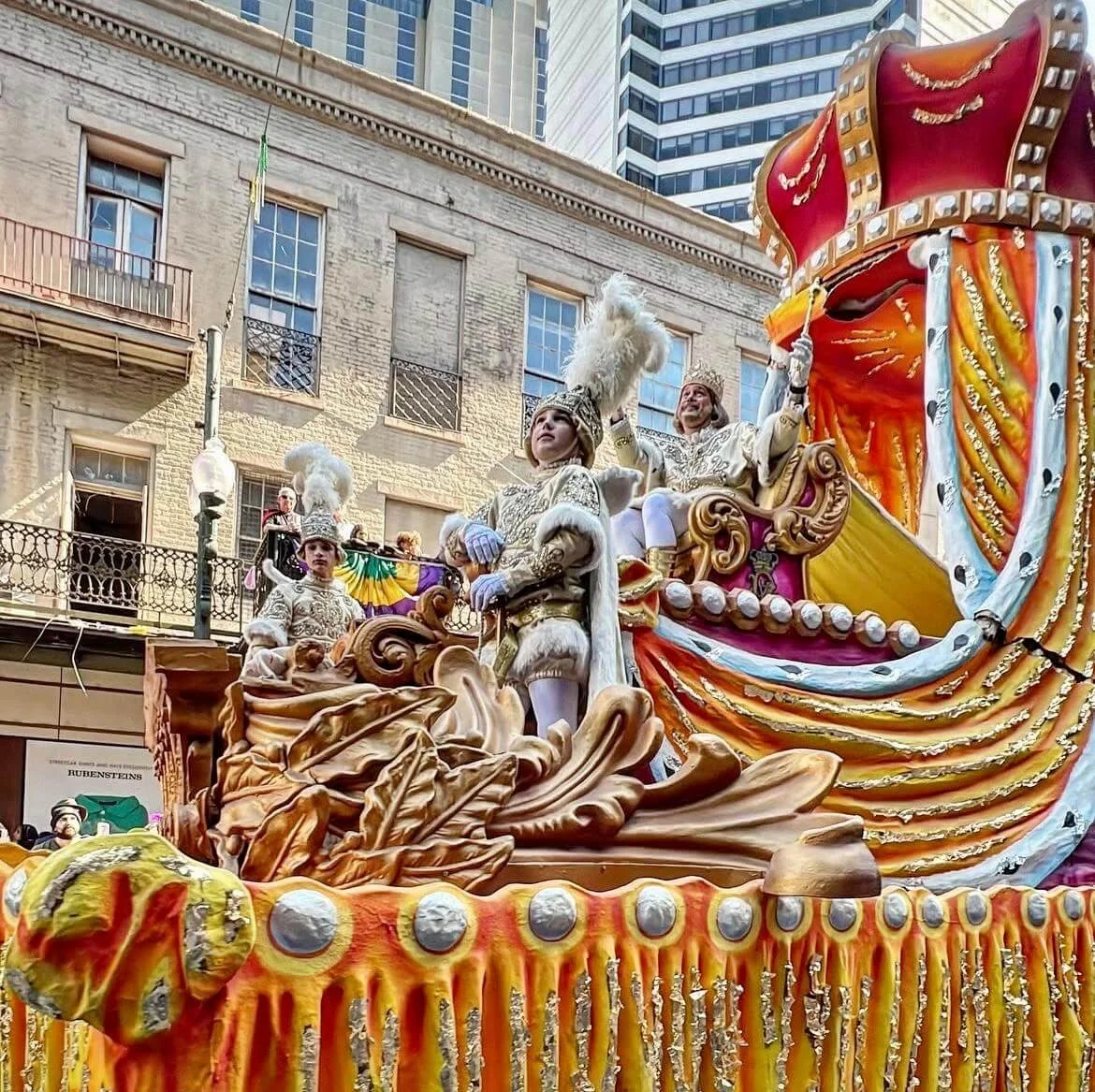
A parade float in New Orleans, during Mardi Gras.
Some places like to fill the chiacchiere with light creams or jams. This requires a thicker dough, and the package is formed much like a ravioli would be, carefully sealing the edges before dunking in the hot oil and deep frying to perfection.
Sweet, fresh wines pair well with the sweet and fried aspects of Carnevale desserts. To truly elevate the experience of artisan sweet foods, the wine must act as a refreshing counterpoint to the richness of the dough while harmonizing with the layers of sugar. When serving traditional sfrappole or citrus-scented tagliatelle fritte, a sweet, organic Albana Dolce is an exceptional choice; its luscious fruitiness and distinct mineral savoriness provide the structure needed to cut through the oiliness of the fry, leaving the palate clean. For those who prefer a more effervescent touch, a sparkling Moscato d’Asti will offer a light, frizzante lift that dances alongside the sweetness without overwhelming it. If you are looking for a more aromatic and colorful pairing to serve with your Carnival treats or even a New Orleans King Cake we will talk about below, the Brachetto d’Acqui is a game-changer. Its vibrant notes of wild strawberries and rose petals create a stunning floral contrast to the citrus zest and cinnamon found in these classic recipes, turning a simple dessert into a true experiential tasting moment.
American Mardi Gras
In America, the undoubtedly most famous Mardi Gras festival is in New Orleans, and is well known for plastic beads flung from parade floats on Bourbon Street and riotous celebrations and parties all over the city. All the same, as it shares the same base for the historical holiday as a kick-off for the restrictions of Lent, food (and wine) were a founding part of this holiday, and still are an important part in the celebrations today in New Orleans. But this history of Mardi Gras in New Orleans, and how it manifests in modern traditions are fascinating.
Beyond the neon lights of Bourbon Street, the true heart of Mardi Gras is preserved through the city’s historic Krewes. These are not merely parade organizers, but dedicated social organizations that spend the entire year hand-crafting the magic of the season. This artisan spirit is most visible in the "Throws", or the coveted, high-stakes prizes tossed from floats that make plastic beads look like an afterthought. From hand-painted Zulu coconuts to intricately glittered Muses shoes, these items are individual works of art, and catching one is a mark of high honor, much like catching a bride’s bouquet.
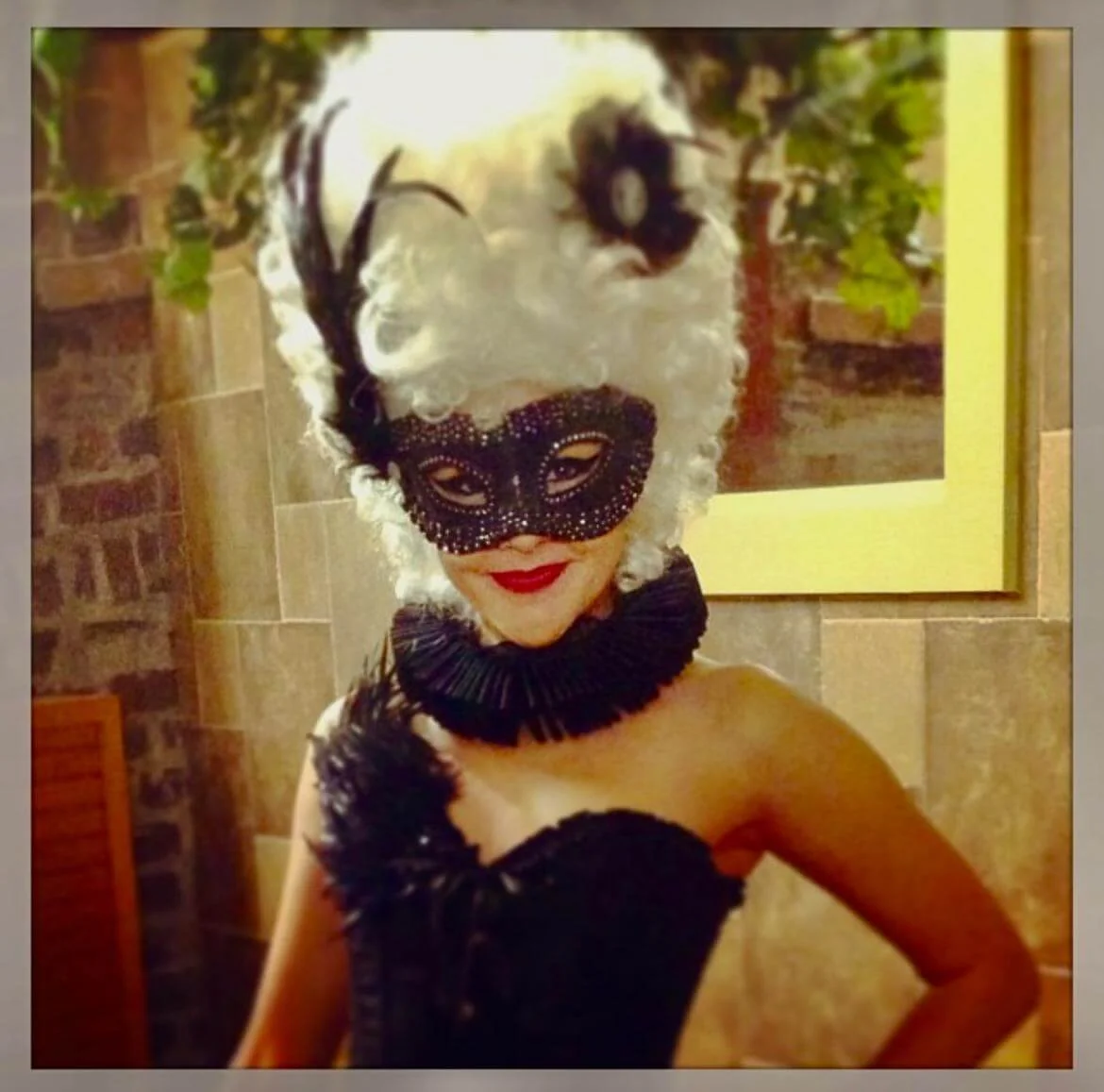
A friend of Vero, dressing up for a real New Orleans Mardi Gras party!
The celebration follows a rhythmic crescendo that locals call "Deep Gras," the intense final five days of the season starting on Fat Thursday and leading up to Fat Tuesday. While the streets are a riot of outrageous, hand-sewn costumes and brass bands, the tradition also maintains a sense of regal theater. The city transforms as massive parades like Endymion, Bacchus, and Orpheus roll through the streets with hundreds of illuminated floats that turn the New Orleans night into a glowing spectacle. The creativity isn't limited to the Krewes, however; the spirit of Yardi Gras sees locals along the parade routes transforming their homes into elaborate stationary floats. Whether you are a rider required to wear a mask by law or a spectator in an outrageous costume, the city is awash in the traditional colors of Purple (Justice), Green (Faith), and Gold (Power).
While many Krewes hold informal walking parades and social gatherings year-round, the tradition reaches its most prestigious heights on Mardi Gras Day. The festivities begin with the historic Zulu Krewe, followed by the Rex Krewe. As one of the oldest and most exclusive organizations, the Rex floats are masterpieces of design. A pivotal moment occurs at Gallier Hall, where King Rex halts his procession to toast his Queen and the City of New Orleans. The entire season finally reaches its solemn conclusion at the stroke of midnight; after the formal Rex Ball, the courts of Rex and the Mistick Krewe of Comus meet in a final, elegant ceremony that signals the official end of the revelry and marks the transition from the "world turned upside down" back to the quiet reflection of the Lenten season.
With the popularity of Mardi Gras rising, several other cities in the US have become well-known for their Mardi Gras festivities. Cities such as Mobile, Alabama (a celebration even older than that of New Orleans), San Diego, California (largest on the west coast), and Galveston, Texas (with larger-than-life inspired parade and floats) all have their part in cementing the roots of modern US Mardi Gras traditions. The holiday has grown in popularity to reach a fever pitch in the modern era, with parade floats becoming more elaborate, and parties more riotous. However, as any travel to New Orleans, or any other Mardi Gras celebration, during the Carnival will tell you: the food and wine are just as important to the celebration as in days of old.
One of the most famous foods associated with Mardi Gras is the colorful King Cake. It is a ring of pastry, similar to that of a cinnamon roll. Toppings vary depending on intricacy and indulgence; some are simply decorated with sugar icing, other with brightly colored toppings of Mardi Gras colors in purple, green, and gold. There is one aspect however, that no true King Cake can do without: a small baby charm. This small plastic charm is baked into the dough, and the person that receives it in their slice is considered extra lucky. Originally intended to symbolize the three wise kings or Magi bestowing blessings, now the more common tradition is that it brings a year of good luck, and the recipient passes that luck on to the next King Cake Party by supplying a new King Cake. Historically, bakeries such as Gambino and Randazzo are reputed to have the best king cakes, although in recent years, other bakeries have come into fashion.

An elaborate Mardi Gras Gala.
Heading into a sugar coma just thinking about all the sweetness in king cakes? Then have no fear, you will find traditional New Orleans, creole heritage inspired foods in all the cafes lining Bourbon Street before the Mardi Gras parades. Savory, belly-filling dishes such as the spicy rice dish jambalaya or the flavorful soupy gumbo are hallmarks of Louisiana cuisine. But they demand wines with the structure to stand up to heat without overwhelming the dish's complexity. For those who prefer white wine, the strategy is all about intensity and high acidity; a crisp, aromatic Riesling is a classic choice because its vibrant fruitiness and precise acidity act as a refreshing cooling agent against the creeping heat of Creole spices. And this goes for whether or not your Riesling is fresh and unoaked, or richly aged in oak. If you are leaning toward red, the key is to look for juicy profiles with low tannins, as high tannins can often clash with chili heat and make the spice feel bitter. The natural wine Ascoltati is a standout here, offering a bright, fresh character, almost like strawberry juice, that complements the smoky and savory notes of a dark roux or spicy andouille. Other excellent red options include a peppery yet juicy unoaked Schioppettino, or a classic Barbera d’Alba, both of which offer the plush fruit and zip needed to keep the palate refreshed throughout a spicy feast. For a true wildcard that bridges the gap between the two cultures, the skin-contact orange wine Saturnalia Bianco provides the unique texture and savory depth to handle everything from a rich crawfish etouffee to a zesty seafood boil.
Carneval in Brazil
Ubiquitous with the idea of Mardi Gras, is also the world-famous Carneval in Rio de Janerio, Brazil. For a week before fat Tuesday, Brazilians party it up with a series of street fairs and parades, filled with those famous images of huge floats brimming with feathered headdresses and eye-popping colors. In fact, the festival in Rio is the biggest carnival party in the world, with sometimes upwards of two million people flooding the city streets every night.
The Rio Carneval is a delightful amalgamation of many different cultures and traditions from various points. The elaborate dress and costumes bring up impressions of Venetian costume balls, spiced up with Latin flair. The gigantic parades are reminiscent of Italian places like Viareggio and Venice, and of course American streets like New Orleans. The street fair atmosphere can at times almost seem to transport you to a world stuck between those of both Rio and New Orleans.
During these nights of heart-pounding music, dancing, and pageantry, food plays an integral part of the celebrations for the locals. Through food and drink Brazilians bring alive old-fashioned traditions, still honored during the insane party season. As chef Jamie Oliver states, “Top foods include traditional Brazilian recipes such as feijoada (slow-cooked pork and beans with rice), moqueca baiana (fish stew) or carurú (a soup with shrimp and toasted nuts). There’s also plenty of street food and sweet treats on offer, such as brigadeiros (chocolate truffles) and quindim – a dessert made of egg yolks, sugar and ground coconut.”
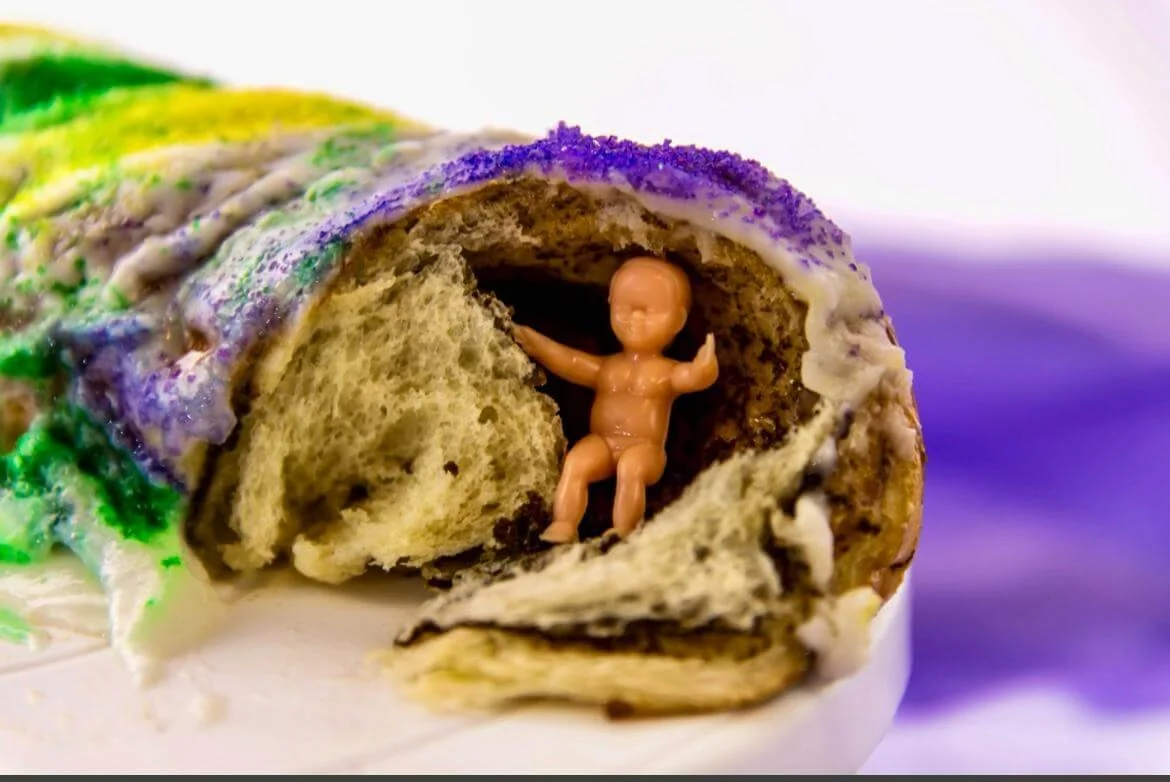
A plastic baby hidden in a king cake.
Mardi Gras vs. Carnevale… Who Wins?
When comparing Italian Carnevale to its New Orleans Mardi Gras cousin, the difference lies in the "spirit" of the party. In Italy, particularly in the celebrations of Venice and other northern regions, the atmosphere is often one of refined mystery and theatrical elegance. It is a visual, costume-driven festival where the mask serves as a beautiful, silent barrier, allowing individuals to step out of their social class and into a dreamlike, historical performance. The focus is on the artistry of the papier-mâché and the preservation of a centuries-old aesthetic that feels like a living museum.
In contrast, New Orleans takes that same tradition and turns the volume all the way up. While the roots are undeniably European, the American expression is bold, playful, and unapologetically loud. If Italy is a masquerade ball, New Orleans is a street-wide jazz party turned celebration. Here, the mask isn't just about secrecy; it’s an invitation to join the "Krewe" and interact with the crowd. While Italy showcases the quiet beauty of a stroll in silk robes, NOLA thrives on the chaotic joy of the throw, the pulse of a brass band, spicy food, and a vibrant, communal energy that pulls every bystander into the parade.
Get Your Wine Selections Ready for Mardi Gras!
Check out below our wine suggestions to go with your own Mardi Gras celebrations at home. For those of you that know our curation style, you know that we love to support small producers and bring you unique fun wines and specialty foods. And you can enjoy these curations by trying a selection of different wines, foods, and olive oils from our portfolio. We sell to both businesses and consumers across the US:
We are enlarging our network of distributors around the country. Reach out to us if you are interested in distributing our products.
We sell to wine stores and restaurants in certain states - contact us if you would like more info.
We do corporate gifts and sommelier guided wine tastings. Email us and we’ll tailor unique and sustainable corporate gift ideas.
If our farm crafted wines, specialty foods, and olive oils are not in your local shop or restaurant buy wine online here and we’ll ship it to you, and we ship to most states.
We also have an award winning wine club for true wine explorers seeking to continually discover unique, sustainable and authentic small production wines they never had.

Delicious flavors of spicy citrus, lemon/lime and ginger is what this unoaked dry Riesling brings to your tastebuds. It has just the right amount of acidity, salinity and sugar to create a natural balance, full mouthfeel and complex sensation in your mouth. From a winery called “Best in the Czech Republic” for multiple years in a row, this wine is farmed organically in a local national park.
Tastes Like: Apples, with a hint of typical riesling rubber
Farming & Winemaking Highlights: Regenerative Agriculture | Sustainable Winery | Organic
Fun Facts: The langoustine or crawdad on the label represents an animal found in the river that flows through the national park where these grapes are farmed.
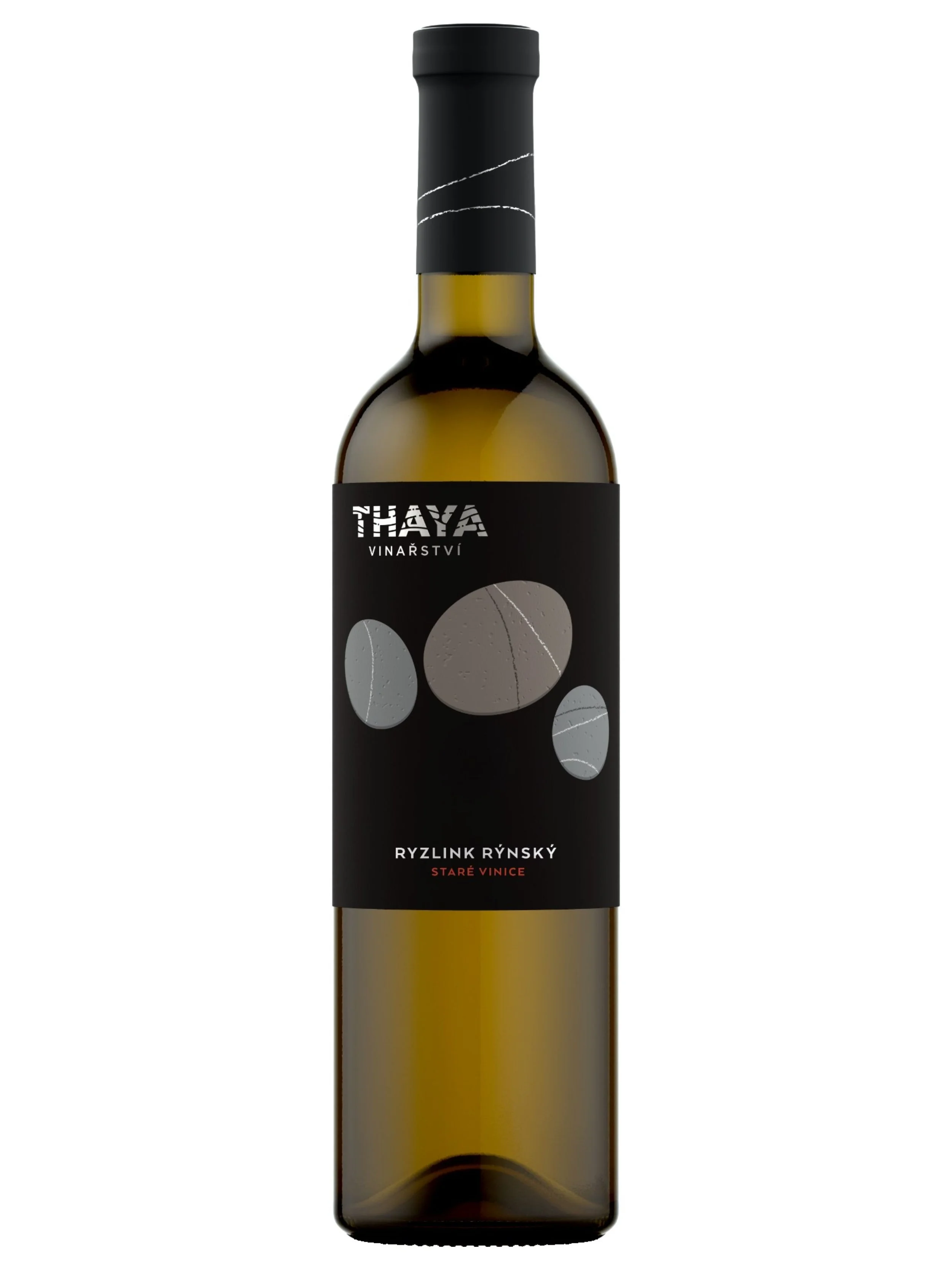
From the Thaya estate winery in the Czech Republic, the fruit for this late harvest dry riesling came from the organically farmed Staré Vinice estate vineyard, which is within a national park. The vineyard is south facing, with granite soils. The wine was made naturally and fermented with native yeast and aged for 12 months in 1,000-liter barrels. This dry, Rhine-style Riesling is golden yellow in color. On the nose, you’ll find notes of lemon ricola, vanilla, chai spice and a distinct salinity that is due to the underlying palate. The palate has a juicy acidity that is in harmony with the citrus notes. The wine has a long finish and excellent potential for aging.

Woman made Saturnalia Bianco, on VinePair’s list of Top 15 Best Orange Wines, is an award winning, unfiltered and delicious skin contact orange wine made from old vine procanico & trebbiano grapes cultivated in volcanic soil.
This natural wine is made from the patented Metodo Corino, based on regenerative farming principles. Nothing is added but grapes! Made with unpressed, free run juice with native yeast fermentation. A two week maceration imparts a dark amber color. Aged only in stainless steel tanks, it has aromas of candied fruit, dried apricot and ginger.
It has pleasant acidity and tannins, and is balanced with a long finish. A pretty deep orange color, it is a great wine for difficult food pairings, it pairs with almost any dish.
Tastes Like: Apricot nectar and chamomile
Farming & Winemaking Highlights: Regenerative Agriculture | Sustainable Winery | Biodynamic | Native Yeast Fermentation | Vegan | No additives (ie non sulphites added) | Unfiltered | Organic | Metodo Corino | Natural Wine
Fun Facts: - The natural farming method that produced this wine, the metodo corino, is actually patented by La Maliosa woman winemaker Antonella Manuli after she helped to develop it with natural wine legend Lorenzo Corino of Case Corini.
- Named in honor of the Roman festival in December which took place near the winery, La Maliosa, this wine was once called Saturnia Bianco.
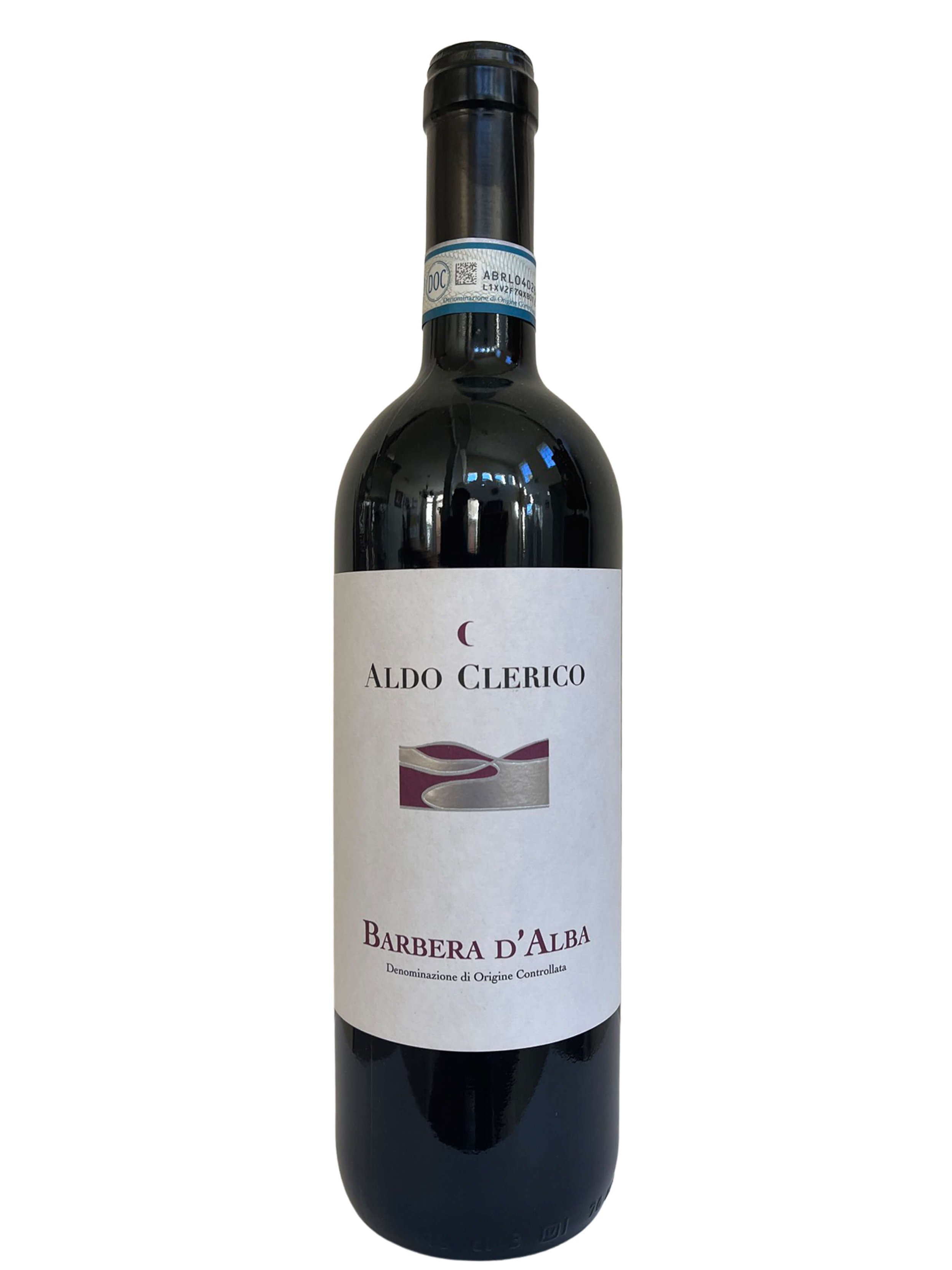
A really good, soft and fleshy Barbera from Alba, from a single vineyard located in the Barolo designated wine region, one of the best areas for Barbera. Nice acidity and fruitiness with some spice, thanks to 14-16 month aging in new and used oak.
A very balanced and elegant wine on the nose, and a good body and structure on the palate with a pleasant and vibrant acidity. A rounded wine with fresh yet fruity notes that finish with a creamy texture thanks to the oak barrel aging.
Do you want to regularly purchase this wine? Check out the Subscribe and Save option available HERE!
Tastes Like: Pretty, ripe, dark cherries
Farming & Winemaking Highlights: Biodynamic | Native Yeast Fermentation | Single Vineyard
Fun Facts: With its aging, this Barbera d’Alba technically follows guidelines for a Barbera d’Alba Superiore, but winemaker Aldo Clerico decides to declassify it.

A fun and fruit-forward red wine, Ascoltati offers an immediate burst of juicy strawberry and floral notes, reminiscent of fresh strawberry juice and a hint of lavender. With a medium acidity and very low tannins, this "glou glou" style wine is deliciously drinkable but still finishes clean with a distinct mineral character. Crafted by Foligodia, this low-alcohol blend of Merlot, Rondinella, and other grapes is a perfect wine for any occasion and is particularly refreshing when served chilled.
Region: Italy > Lombardy > Mantova
Tastes Like: Strawberry Juice
Farming & Winemaking Highlights:Regenerative Agriculture | Sustainable Winery | Biodynamic | Native Yeast Fermentation | No additives | No Sulfites added | Unfiltered | Organic | Natural Wine
Fun Facts: The name ascoltati means “listen” in Italian.
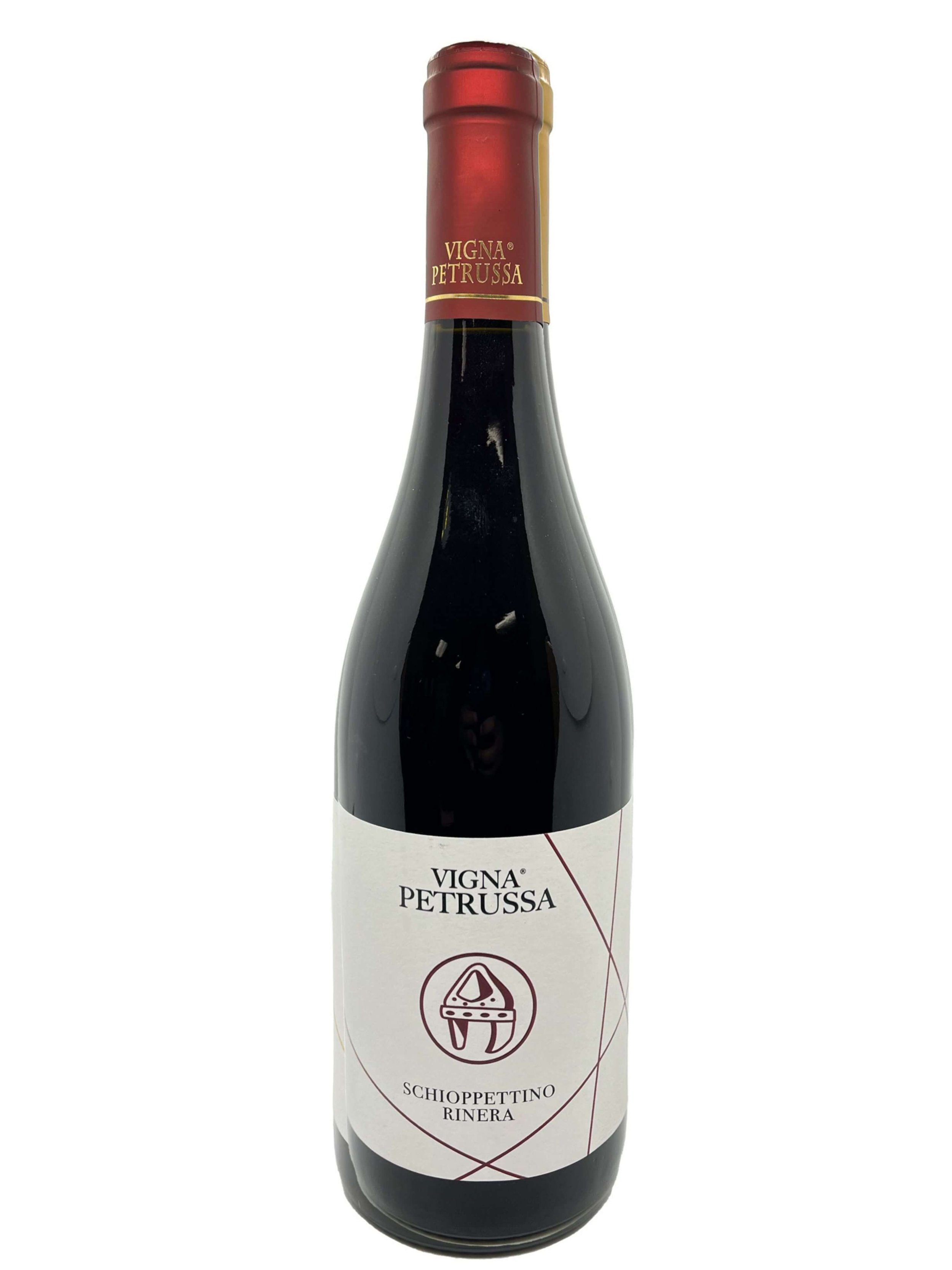
This is an unoaked Schioppettino from a women owned winery who spearheaded the rebirth of Schioppettino in the 'birthplace' of the grape which is Prepotto, Fruili. Having a deep purple-garnet color, it has notes of black pepper and dark fruit. Its taste is tangy, fresh and juicy with a long clean finish. Pairs with many dishes from hamburgers to roast pork. World renowned wine critic, Ian D’Agata calls this Schioppettino a ‘very pretty wine’ and named it a 'Best Buy Italian Wine'.
Some fun facts about this wine:
Vigna Petrussa also calls this wine ‘RiNera’, or a nickname for ‘Ribolla Nera’, local term given to the wine.
The grapes actually come from Prepotto but since it is not aged in oak the winery is not 'allowed' to put Prepotto on the label.
Vigna Petrussa is a certified sustainable and biodiverse women-owned winery.

With an inviting golden yellow color, this fresh and softly balanced sweet wine made from the historic Albana grape from the Romagna area of Italy has intriguing saffron and apricot notes. As a sommelier pointed out when tasting the wine for the first time: ‘It’s a dessert wine that is sort of a dry wine.. Wow, this whispers, not shouts!’
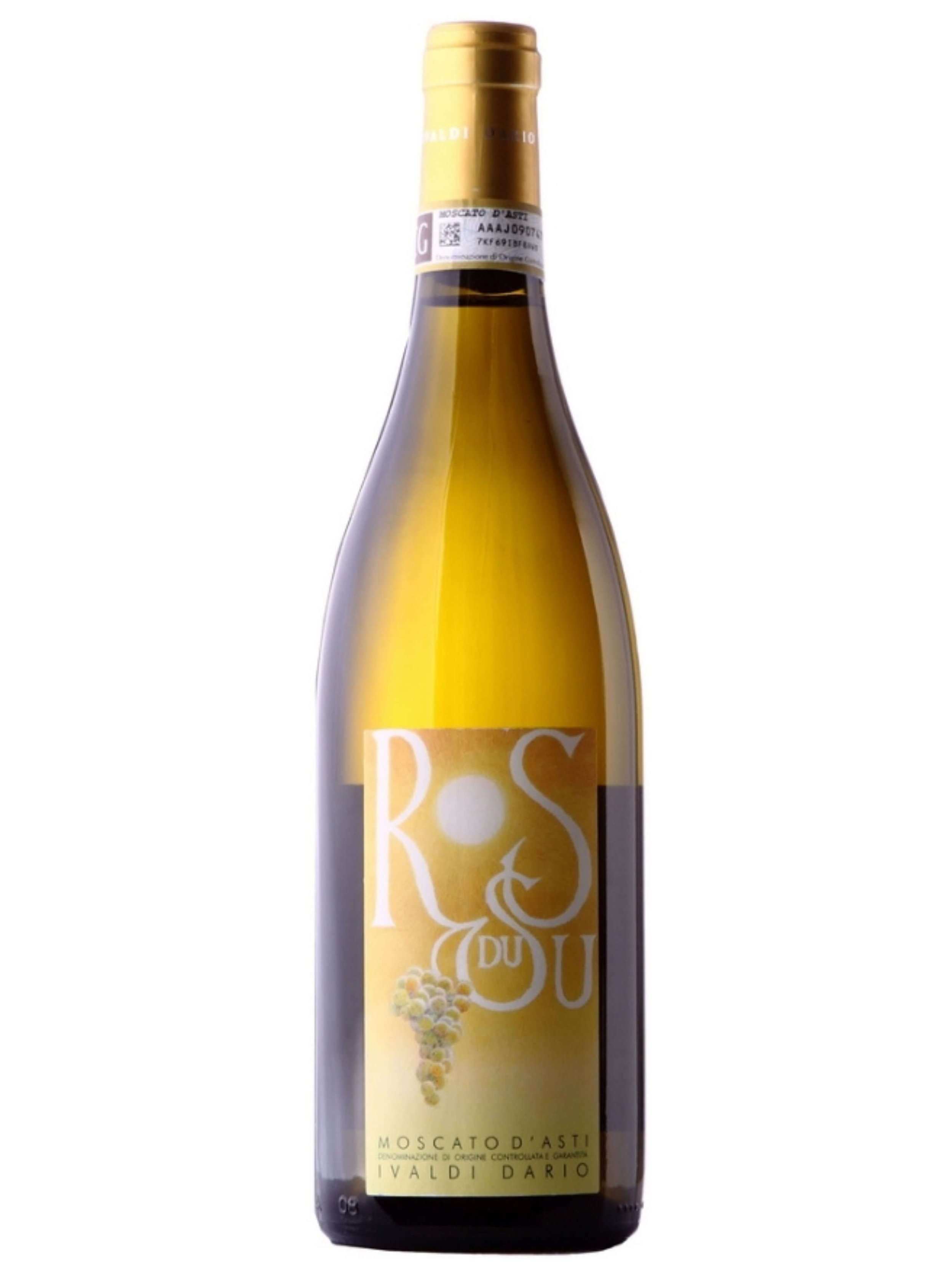
Who doesn’t like chamomile and honey? That’s what this wine reminds you of! It’s a Moscato d’Asti that appeals both to sweet wine lovers and dry wine drinkers wanting a moment with a touch of sweetness.
The name of this wine, Ros du Su, means ‘Rays of Sunlight’ in Piemontese dialect where this Moscato d’Asti comes from. Looking at its bright, golden-yellow color, it is easy to understand the inspiration for this name.
In the glass, the aromatic qualities of moscato are the first noticeable aromas, but underneath subtle and persistent notes of honey and acacia and chamomile flowers come forth creating a complex bouquet. Tasting, the sweetness of the residual sugars are well balanced with freshness and sapidity. A pleasant wine that keeps you sipping, it pairs well with desserts, but is every bit as enjoyable alone in contemplation.
A certified sustainable winery, Ivaldi practices regenerative farming.
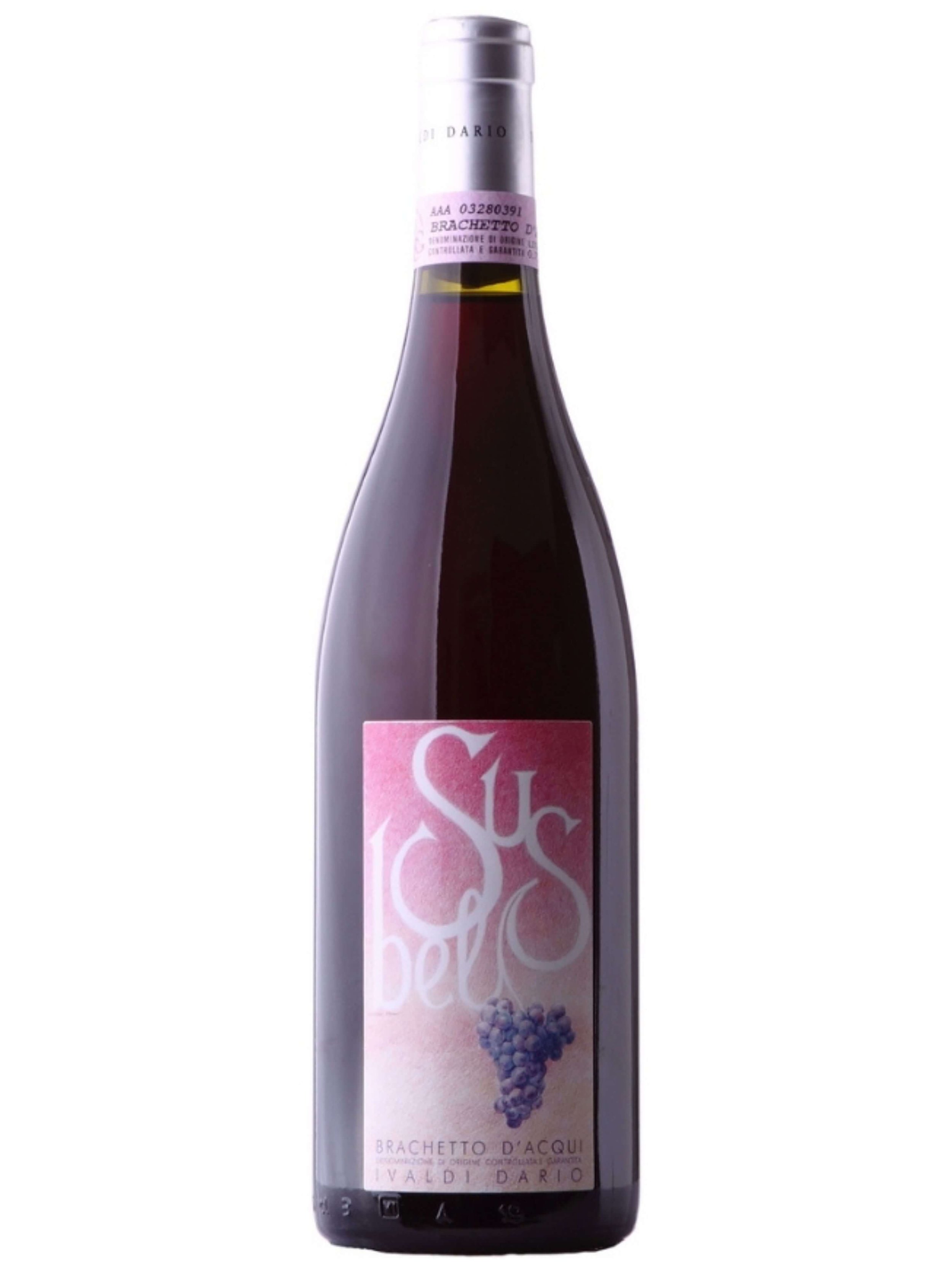
“Can we make Brachetto popular, please?” is how VinePair headlines why this artisanal, aromatic red sweet sparkling wine, just recently imported by us first time to the USA, made it to VinePair’s list of 13 Best Sweet Wines.
An aromatic grape, brachetto, creates a pleasantly slightly sparkling sweet red wine, with delicate rose flower and strawberry notes and strawberry and hibiscus taste. ‘Susbel’, in the local Piemontese dialect of Ivaldi in the Monferrato, refers to the location of the vineyard of this Brachetto d’Acqui, where the sun is bright and well exposed.
Left four days in contact with the skins and fermented with native yeast, this natural wine has a bright and clear light red color, dotted with fine effervescent bubbles. Sipping, the immediate impact is indeed sweet, yet with enough acidity and a hint of tannins to create a harmonious and balanced wine that keeps you coming back for more.
Wonderful to serve slightly chilled to sip with friends in the backyard on a hot summer day, or to serve with fruity desserts. Try pairing it with white or milk chocolate or a savory cheese, like with Humboldt Fog goat cheese - it goes incredibly well. It can also pair with charcuterie. Made with native yeast fermentation and has a residual sugar of 120 g/l.
A certified sustainable winery, Ivaldi Dario practices regenerative farming.