The Wines of Aldo Clerico, as Told by Aldo Clerico
We’ve been to see winemaker Aldo Clerico in the Langhe before, but this time the idea was simpler. No rush, no agenda, just a chance to chat. In these hills, Aldo makes Barolo and a small range of red wines with the same steady, no-nonsense approach that has always defined his work. Before we talk about the wines themselves, their style, and how they are made, we wanted to spend a little time with the man behind them: his story, his life in the vineyard, and the experiences that have shaped the bottles he puts on the table.
Who is Aldo Clerico?
We’ve known Aldo Clerico as a winemaker in the Langhe for a while now, but his story starts somewhere else entirely. His father was a fireman, he studied accountancy, and for a time he followed the sensible road of office life, until one day that was enough. He wanted something more practical, more real, and that eventually led him into wine, first working with his cousin Domenico Clerico and then starting his own project. Of course by his side was his family: his parents and his wife Valentina (from a storied Barolo making family as well).
The beginning was far from polished. His first harvest in 2004 was total chaos: the winery was still being finished, there were holes in the walls closed with styrofoam, no proper floor, and barely enough room to move. It was noisy, cramped, and a little bit crazy, but also the kind of first year you never forget. And maybe that is why it meant so much. There was the excitement of starting something new, but also all the doubts that come with it. Aldo said, “Sarò capace?” Can I really do this? But do it he did indeed.
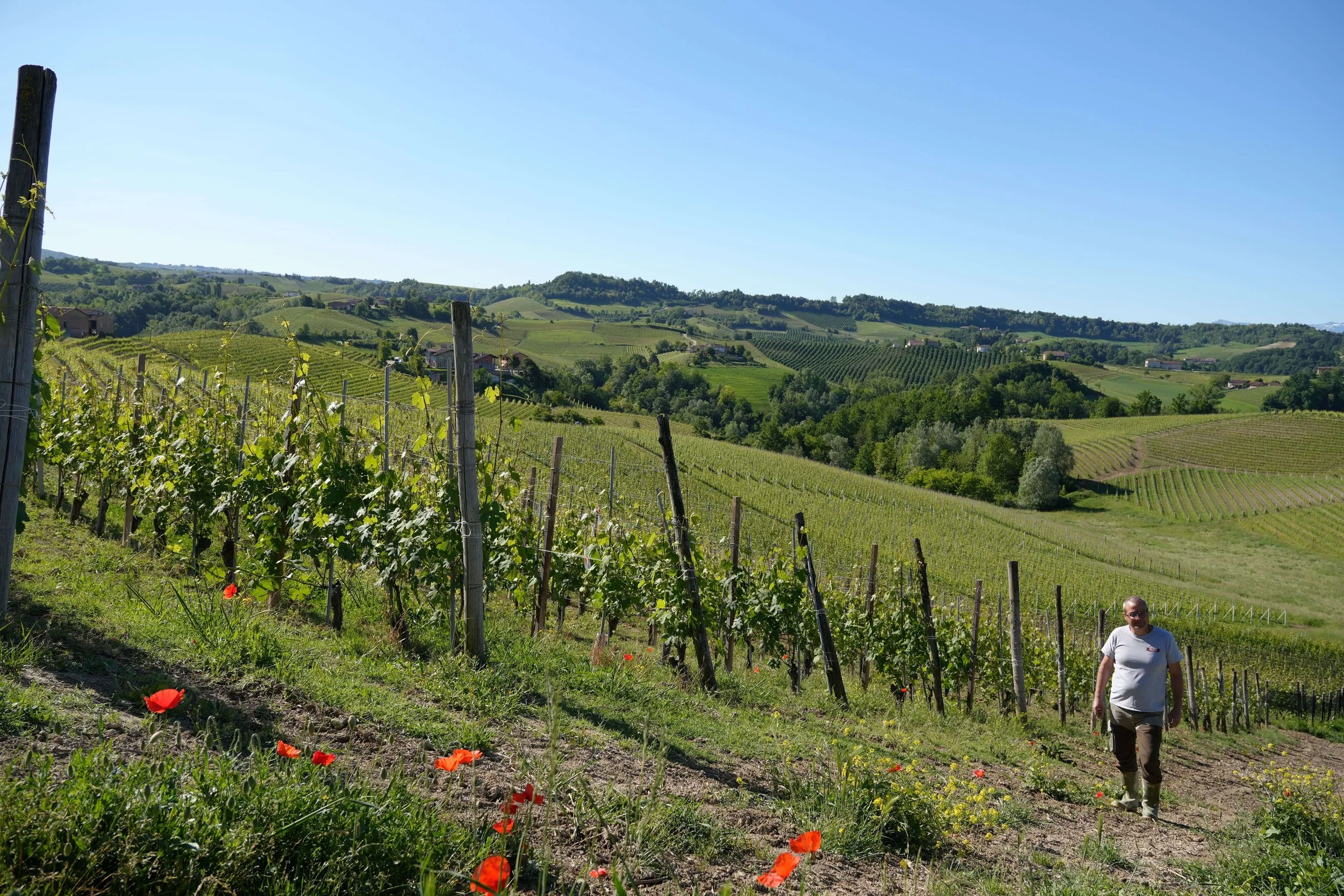
Aldo in his Monforte Langhe Nebbiolo vineyards, in front of his home.
He is not one for shortcuts or fancy talk. As he likes to say, “fare buon vino non è un segreto: ci vuole passione”. Good wine is not a secret, it just takes passion. And he really means it. He wants to be the first one to drink his wines, because, as he puts it, he has to like them. He enjoys getting to talk and connect with people and fans of his wine, but, at the end of the day, he says “un bicchiere vuota parla più forte di qualsiasi racconta”, an empty glass says more than any story. This is why for him wine is something that creates friendship, empathy, and love; it’s what makes wine more than just a liquid to drink, but an experience.
Hear it From the Man Himself
Our interview with Aldo, as always, weaves through plenty of different topics, from life in the vineyard to the way he thinks about farming, the weather, and the wines themselves. He speaks in the same practical, direct way he works, which makes the conversation easy to follow and full of little details. So let’s pick it up from here.
What’s New & the Challenges of Farming
V: We’ve written quite a few articles about you in the past… anything new we should touch on before jumping into the wines?
A: There are a couple of new Nebbiolo vineyards, and that is always a good thing. One of them was planted only a few weeks ago, so of course it will take time, but that is how this job works. At this point there is a bit less of the hands-in-the-dirt work and a bit more managing, checking, making sure everything is done properly. I still like being out there, especially at harvest, because that is when you really see what the year has given you. But yes, you also have to keep your eye on everything and be ready to adapt. In the end, the weather always decides a lot anyway.
V: So the weather has been tough? How are you adapting then?
A: Yes, the weather has been more difficult, but that is part of the job. Every year is different, so you cannot do the same thing and expect the same result. You have to look at the season, understand what is happening in the vineyard, and adapt. Sometimes that means changing how you prune, sometimes it means changing the timing, but in the end you just have to stay attentive and work with what nature gives you. Because the most important thing is still the grapes. If the grapes are healthy and good from the beginning, then you do not need those fancy machines and interventions that take out acidity, or add complexity or whatever you need to turn bad grapes into good wine. Those things can help fix problems, but they cannot replace doing the work properly in the vineyard from the start.
The Wines of Aldo Clerico
We asked Aldo about each of his wines, from how they are made to the little details that make them what they are, and of course the memories that go with them: the good, the bad, and the ugly. As always with Aldo, the conversation moves easily between the technical and the personal, between vineyard, cellar, and family life. So let’s go wine by wine and hear the stories behind the bottles.
Dogliani Dolcetto DOCG
V: So tell us a little bit about the Dogliani, how is it made?
A: My Dogliani wine comes from 100% Dolcetto in Monchiero, from south-facing vineyards sitting around 380 metres up, on marl and clay soils. The vines are quite old, between 35 and 45 years, and I always harvest by hand in mid September. I keep the fermentation short in stainless steel, and then the wine spends some time resting in tank so it keeps its freshness and drinkability.
V: What is a special memory or vintage that you associate with the Dogliani?
A: For the Dogliani, I always think back to 2004. That was the first grape I ever harvested, and of course it was my first harvest too. So for me, it will always be tied to the beginning of the whole story. It was the year everything became real, and that is something you never forget.
Barbera d’Alba DOC
V: Let’s move on to the Barbera now, how is it made?
A: My Barbera d’Alba comes from 100% Barbera grown in Monforte d’Alba, on south and south-east facing vineyards at around 400 metres above sea level. The vines are about 40 to 50 years old, and the soils are made up of calcareous and clay marl, which give the wine its structure and energy. I harvest by hand in early October, ferment the wine in stainless steel, and then let it mature for at least a year in oak barrels.
V: What is a special memory or vintage that you associate with the Barbera?
A: For the Barbera, 2025 was definitely the vintage that left its mark. It was one of those very challenging years where nothing seemed to go quite as planned, and the fermentation went on much longer than expected. But maybe that is exactly why I remember it so well, because even with all that, I was still able to make a great wine. So yes, it was a challenging year, but I am very happy with the result so far.
Langhe Nebbiolo DOC
V: Now we enter the famous Nebbiolo territory, how is the Langhe Nebbiolo made?
A: My Langhe Nebbiolo comes from 100% Nebbiolo grown in Monforte d’Alba, from some younger vines planted on south and south-east facing slopes at around 400 metres above sea level. Technically, these are Barolo vineyards, but because part of the fruit comes from younger vines, the wine gives me a fresher and more immediate expression of Nebbiolo. The soils are again calcareous and clay-rich marl, and I harvest by hand in the first days of October. I ferment it in stainless steel, then let it age for a year or so in oak, which helps round it out while keeping its character.
V: What is a special memory or vintage that you associate with the Langhe Nebbiolo?
A: For the Langhe Nebbiolo, I think of 2024, because it was a year when we had to move quickly and stay very alert. We knew the weather was changing, so everything had to be harvested in a short window before the rain came. And harvest is always the moment I like most, because that is when you see the results of the whole year, from winter pruning to spring work to summer vineyard care. It is the point where everything comes together. So it was a shame I didn’t get to enjoy the harvest like I normally do getting into the vineyard to harvest… not even one cluster! And when I think of this wine, I also think of the six rows in the vineyard in front of the house, with the rose bushes at the ends: each one named for a member of the family. The shortest row is my youngest daughter’s, and the longest is mine, of course.
Barolo DOCG
V: The first Barolo, your classic one, how is it made?
A: My Barolo comes from 100% Nebbiolo grown in Monforte d’Alba, on south-facing slopes at around 400 metres above sea level. They come from 5 different vineyards, all within the Bricco San Pietro cru. The vines are about 40 to 50 years old, planted in calcareous and clay marl soils, and I keep the yield very low so the fruit can really speak clearly. I harvest in the second half of October, ferment the wine in stainless steel, and then age it for two years in barriques and oak casks, followed by another year in bottle.
V: What is a special memory or vintage that you associate with this first Barolo?
A: For the classic Barolo, the memory is simple: it is the wine that started it all. It was the first Barolo, when I started my only Barolo and the one that really marked the beginning of the project, so of course it will always have a special place for me. The other Barolo’s, while special in their own way, came much later. It is this one that is the wine where everything that came before finally became real, and that is something you never forget.
Barolo del Comune di Serralunga d’Alba DOCG
V: Your single vineyard Barolo from Serralunga, how is it made?
A: My Barolo from Serralunga d’Alba also comes from 100% Nebbiolo, from a vineyard in the Serralunga d’Alba MGA or cru. Harvest is usually in the second half of October, and then I ferment the grapes in stainless steel, and then let it rest for two years in barriques and oak casks, followed by 12 months in bottle.
V: What is a special memory or vintage that you associate with the Serralunga Barolo?
A: For the Serralunga Barolo, I always think of 2020. It was a very difficult harvest because there was so little help available, and we had to manage everything with much less support than usual. That vineyard has always reminded me of what we call a “vita gràma”, or Piemontese dialect for a hard life or a really ugly and difficult life, because it was an old vineyard and a very demanding one to work. So this wine carries that memory of effort, patience, and a lot of hard work in the vineyard.
Barolo Ginestra DOCG
V: And finally, the Barolo Ginestra, how is it made?
A: My Barolo Ginestra comes from 100% Nebbiolo grown in the Ginestra vineyard in Monforte d’Alba, on south-facing slopes at around 350 to 400 metres above sea level. The vines are about 35 to 40 years old, the soils are calcareous and clay-rich marl, and the vineyard gives me a very limited yield, which is part of why this wine has such concentration and character. I harvest in the second half of October, ferment it in stainless steel, and then age it for two years in oak casks, followed by another year in bottle.
V: We know in the past you always associate this Barolo Ginestra with your heart and daughters, any other memories?
A: For the Ginestra, 2014 is always the vintage that comes to mind. It was the first year the wine came out, and it was also the year my first daughter was born, so it is linked to both the wine and the family in a very special way. That makes it a particularly meaningful Barolo for me, because it is tied to a moment when two important things in my life began at once.
V: And that wraps it up for us. Thank you, Aldo, for your wonderful hospitality, as always, and sharing in this chit chat and delicious wines!
A: Thank you for coming in and tasting all my wines today. After all, for all I love to talk about my wines, I still believe an empty glass at the end of a tasting speaks more than a thousand words!
Taste Aldo’s Passion
So there you’ve heard it from the man himself. Are you ready to try his passion driven, artisan made wines from the Langhe and Barolo area? Find them in the VeroShop, or try a few different selections in Aldo-Themed VeroSets (with shipping included for your entire order), like the Langhe Red Trio, Barolo Single Vineyard Cru Explorer Set, and the Nebbiolo-Barolo Tasting Set.
For those of you that know our curation style, you know that we love to support small producers and bring you unique and fun wines, and specialty foods. And you can enjoy these curations by trying a selection of different wines, foods, and olive oils from our portfolio. We sell to both businesses and consumers across the US:
We are enlarging our network of distributors around the country. Reach out to us if you are interested in distributing our products.
We sell to wine stores and restaurants in certain states - contact us if you would like more info.
We do corporate gifts and sommelier guided wine tastings. Email us and we’ll tailor unique and sustainable corporate gift ideas.
If our farm crafted wines, specialty foods, and olive oils are not in your local shop or restaurant buy wine online hereand we’ll ship it to you, and we ship to most states.
We also have an award winning wine club for true wine explorers seeking to continually discover unique, sustainable and authentic small production wines they never had.

Dogliani is known as the area which produces the best dolcettos in the world. This expressive structured yet easy-to-drink red wine has purple color, and floral bouquet with red plum notes. On the palate, this dolcetto opens pleasantly with notable tannins that are, however, not overpowering. It finishes with light almond notes. Coming from a single vineyard near Monchiero, this Dogliani is also make with native yeast fermentation.
It can be enjoyed just after bottling, yet it can better itself after a bit of aging in bottle.
Tastes Like: Juicy plump, plums
Farming & Winemaking Highlights: Biodynamic | Native Yeast Fermentation | Single Vineyard
Fun Facts: Originally called Dolcetto di Dogliani, local winemakers lobbied to change the denomination to simply ‘Dogliani’ to avoid the misconception that this wine was ‘little sweet’, as suggested by the translation of ‘dolcetto’ in Italian. They wanted this special dry red wine to be able to make its own name, and let its importance stand for itself.
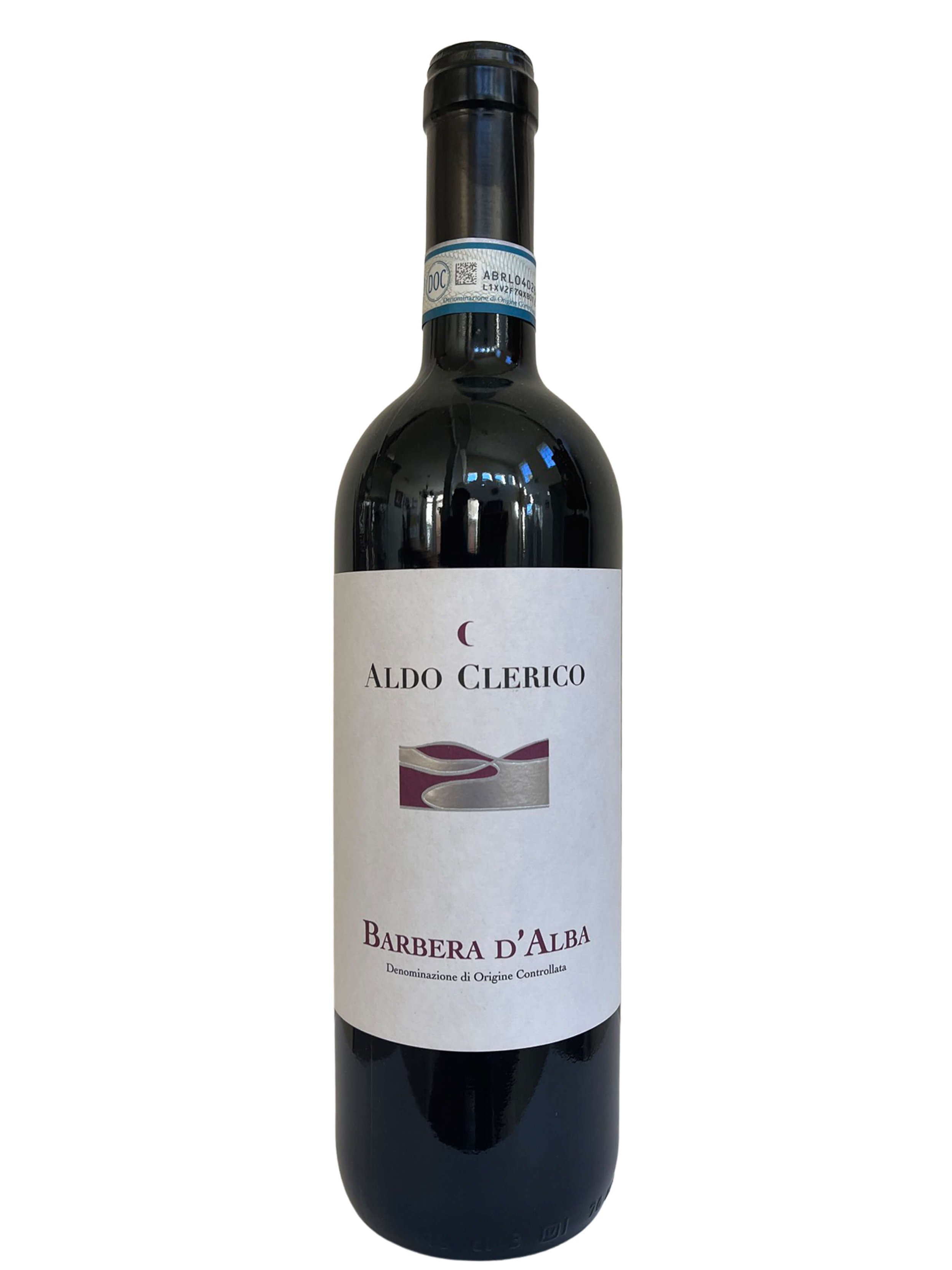
A really good, soft and fleshy Barbera from Alba, from a single vineyard located in the Barolo designated wine region, one of the best areas for Barbera. Nice acidity and fruitiness with some spice, thanks to 14-16 month aging in new and used oak.
A very balanced and elegant wine on the nose, and a good body and structure on the palate with a pleasant and vibrant acidity. A rounded wine with fresh yet fruity notes that finish with a creamy texture thanks to the oak barrel aging.
Do you want to regularly purchase this wine? Check out the Subscribe and Save option available HERE!
Tastes Like: Pretty, ripe, dark cherries
Farming & Winemaking Highlights: Biodynamic | Native Yeast Fermentation | Single Vineyard
Fun Facts: With its aging, this Barbera d’Alba technically follows guidelines for a Barbera d’Alba Superiore, but winemaker Aldo Clerico decides to declassify it.

It is a wine with great structure and personality, an excellent expression of the nebbiolo vine. With a delicate floral bouquet of rose and violets, there is also a finish of licorice. Tasting it really brings out its elegance with pleasant yet decisive tannins that signal great potential for good aging.
As well, the native yeast fermentation used to make this nebbiolo natural wine lets you taste the natural terroir of the Langhe.
Tastes Like: Crunchy pink cherries
Farming & Winemaking Highlights: Biodynamic | Native Yeast Fermentation
Fun Facts: This Langhe Nebbiolo is known as a ‘Baby Barolo’, since it comes from Barolo vines, and is a great introduction to the Langhe wines, where some of the best reds in the world come from.

This is one of the best Barolo wines from the Langhe in Piedmont Italy as well as a great value from one of the storied families of Barolo wineries. This Barolo red wine is the maximum expression of the nebbiolo grape from Aldo Clerico. With vineyards right next to those of Domenico Clerico Barolo vineyards, this Barolo is a good substitute for Burgundy wine.
This garnet colored artisan Barolo has red fruit, rose and spicy leather and tea leaf aromas with elegant structure, long finish leaving a silky mouthfeel. On the nose it is very intense while floral notes mix with typical vineyard scents of violets and red berries. On the palate, the violets blend with licorice flavors and noticeable tannins. A creamy texture from the oak barrels creates a pleasant mix of fresh yet complex flavors.
Tastes Like: Cherries and licorice
Farming & Winemaking Highlights: Biodynamic | Native Yeast Fermentation | Single Vineyard
Fun Facts: This is Aldo's first wine made from 5 different Barolo designated vineyards surrounding his home in Monforte d'Alba, all within the Bricco San Pietro MGA. He vinifies each vineyard and then does an assemblage, creating each vintage a unique expression of his nebbiolo vineyards. It is also made with native yeast fermentation, so can be called a natural wine.

Made with native yeast fermentation, this Barolo Serralunga is a special natural wine. Rich on the nose with dried violets typical of the nebbiolo grape, the bouquet is austere and profound with balsamic notes. Once sipped, the earthy texture is out of this world, which marries pleasantly with the structure, fruit and spice of this elegant red. Well accented tannins are soft and decanting is strongly recommended.
Tastes Like: Earthy Spices
Farming & Winemaking Highlights: Biodynamic | Native Yeast Fermentation | Single Vineyard
Fun Facts: This is a single vineyard Barolo from the Serralunga d'Alba village, known to produce the most age worthy Barolos.

Made from the sought-after Ginestra Barolo Cru, this single vineyard wine epitomizes the greatness of the nebbiolo grape from the Barolo wine region, in terms of structure, age-worthiness and fruit expression. The native yeast fermentation used in making this natural wine also helps bring out the special and sought after terroir of the Ginestra cru.
An intense garnet color, on the nose this Barolo tends towards red fruits, with a touch of balsamic notes. As it opens on the palate the elegant tannins harmonize with the acidity for an overall richness that creates a pleasant and enjoyable experience while sipping alone or with food.
Tastes Like: Balsamic Tabacco leaves
Farming & Winemaking Highlights: Biodynamic | Native Yeast Fermentation | Single Vineyard
Fun Facts: The Ginestra cru is very limited and only a few wineries have access to harvest from there. Aldo can thanks to his wife’s, Valentina’s, Conterno family vineyards.
Fun Facts: The hands on the bottle represent Aldo’s two daughters; for this reason he often says this is the wine closest to his heart.
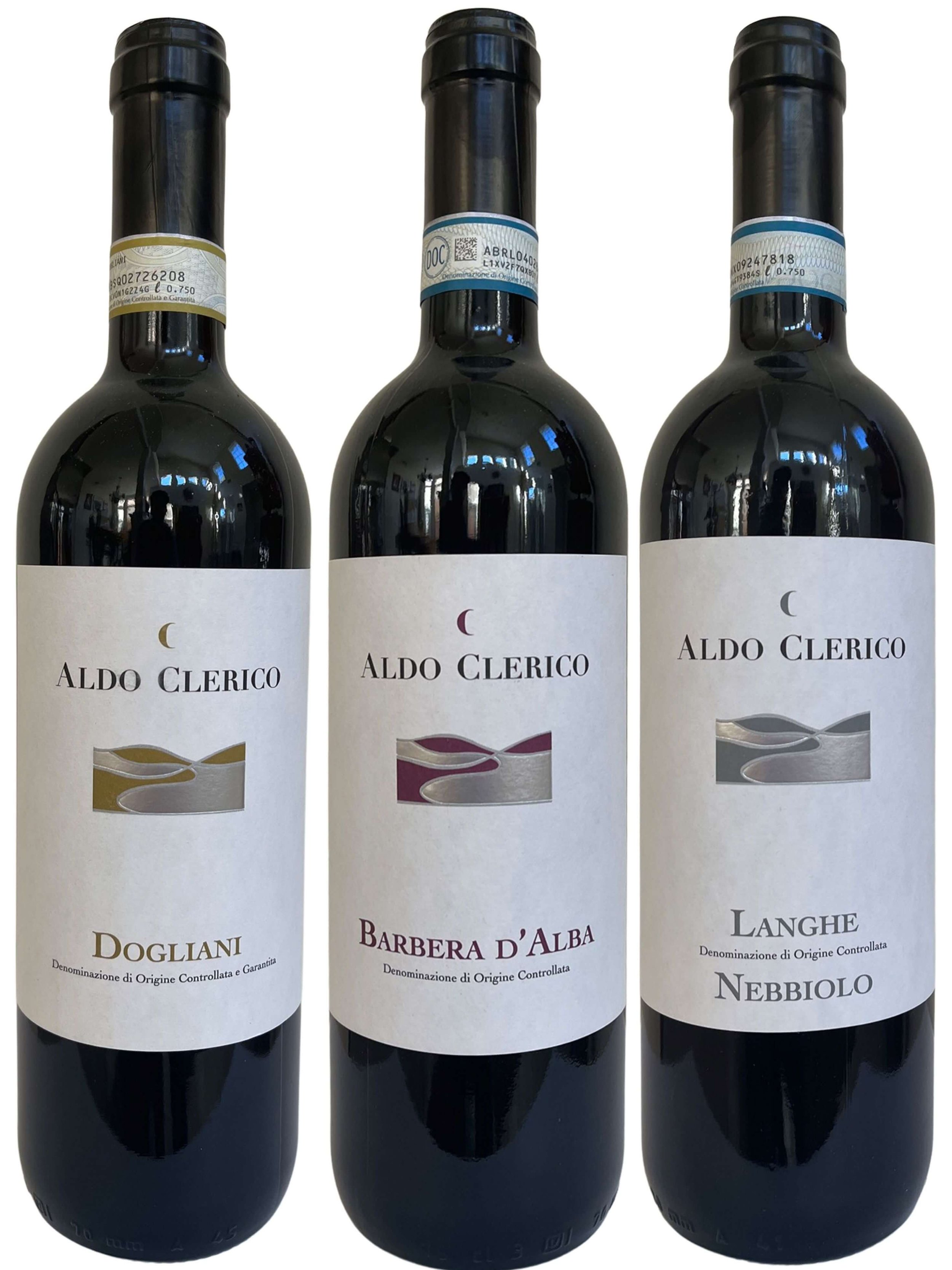
Tucked in the hills of Northern Italy is a land of rolling hills covered in vineyards known as the Langhe. While famous for the Italian King of red wines, Barolo, there are several other varieties that hail from the area that are just as delicious. Wines made with grapes from Dolcetto, Barbera, and Nebbiolo are prized from the Langhe, and native born producer Aldo Clerico has them all in his blood. In this set, try these less famous jewels of Piedmont and the Langhe: a dolcetto from Dogliani, a Barbera d’Alba, and a Langhe Nebbiolo… all from the cream of the crop vineyards in Piedmont.
Shipping in the Continental US is also included for this set, and extends to any other products you add to your order… so this is an excellent time to add on a Barolo or two from the Langhe.
These wines were featured in a VeroTalk with winemaker Aldo Clerico and Vero Chef Jacqueline Mitchell live from Italy in an authentic Italian Trattoria! Watch this virtual food and wine pairing event HERE.
Included in this box are:

Barolo is considered one of the most sought after red wines in the world. It’s made from the nebbiolo grape, which is know for having a great balance between acidity and tannins, and ages very gracefully.
This set contain a Barolo DOCG and ‘Baby Barolo’, a Langhe Nebbiolo made from Barolo vines, by Barolo area native, Aldo Clerico, in Monforte d’Alba.
Any red wine lover, especially one seeking hard-to-find treasures, would enjoy side by side to compare Aldo’s Barolo and his Baby Barolo, Langhe Nebbiolo! Barolo’s elegance, aging ability, and fullness of character all blend together to create a delicious red wine that lingers on the palate.
This special offer set has shipping included for the Continental US. Great as a gift!
Included in this box are:
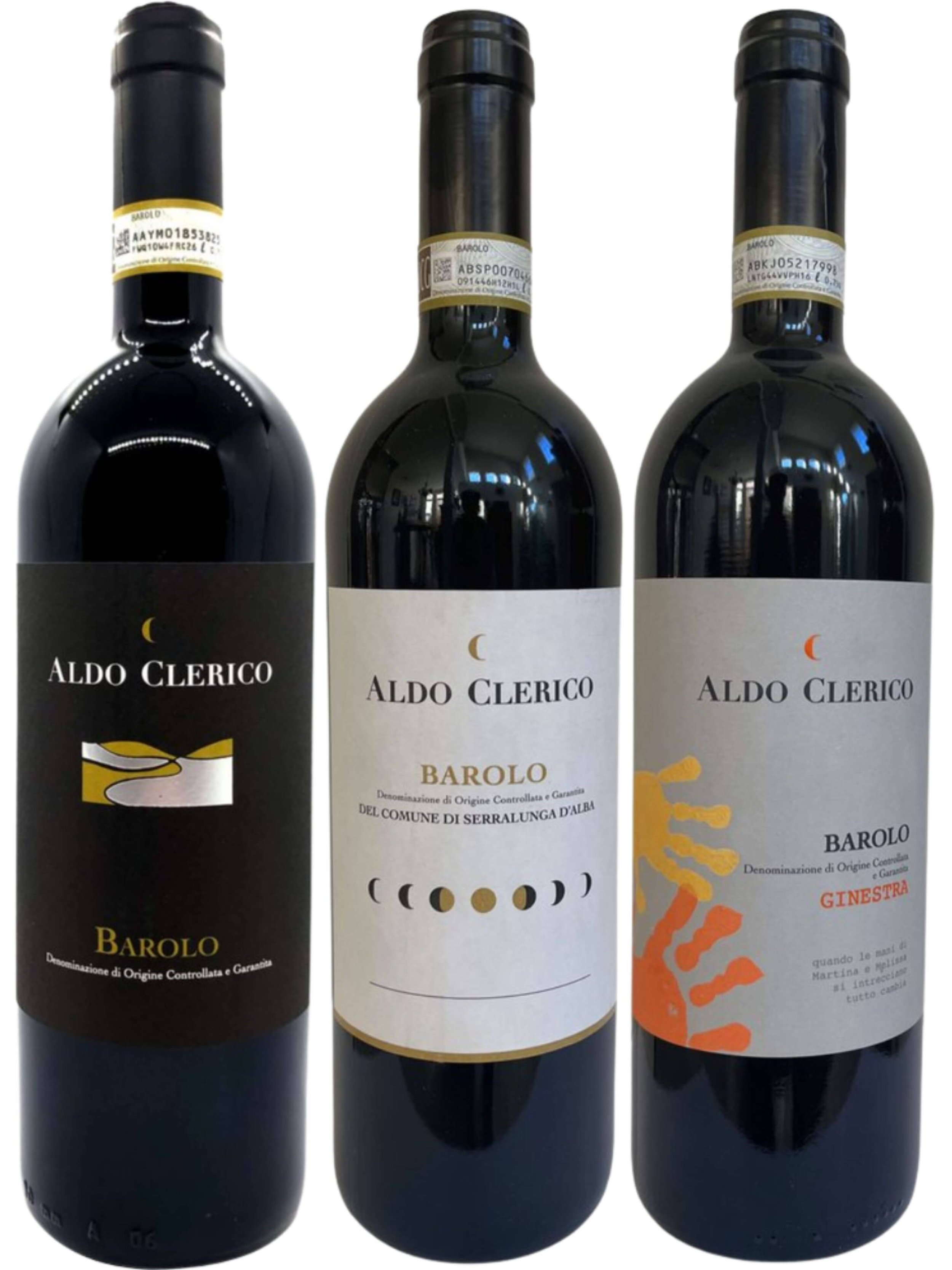
Barolo is one of the best red wines in the world. Made with 100% nebbiolo, it must have at least 3 years of aging before release. But are all Barolo’s the same? Certainly not!
This Barolo Gift Basket is for the true wine connoisseur, consisting of Barolos from different villages, MGAs (or CRUs), vineyards, all with different terroirs, each producing a Barolo with different nuances.
This gift set includes:
Aldo Clerico’s Classic Barolo estate sourced from multiple storied vineyards around his home;
Single vineyard Barolo Ginestra, a highly sought-after MGA, or Cru, well known for its exclusivity where Aldo Clerico has an "in" thanks to his wife also coming from a legacy Barolo family;
Single vineyard Barolo Serralunga d’Alba coming from the area of the Barolo wine region with the oldest terroir, resulting in an a super age worthy Barolo with the earthiness and mouthful of a volcanic wine.
Shipping included for orders in the Continental US with this set, so feel free to add on other Piemonte wines (like Langhe Nebbiolo) to try!
This set includes: